

If you own property in Woodstock, you already know the trees here get big.
Sugar maple, pin oak and black walnut all do well in this ground. That is good news for shade and bad news when one of them leans toward your roof.
We work Woodstock regularly, from the properties near the Woodstock Tower and the Seven Bends overlook out to Edinburg, Maurertown, and Toms Brook. Here is how we approach removal, pruning and stump grinding in this specific area.
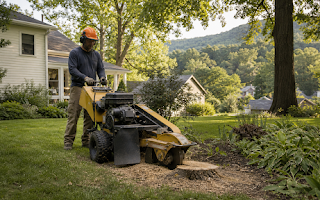
A stump is not neutral. It is a slow problem.
Grinding it out takes an hour on most jobs. Living with it takes years.
Wind and ice damage trees differently.
Wind pushes. It takes trees over at the roots when the ground is soft, or snaps trunks where there is already decay inside.
Ice loads. A quarter inch of ice can add hundreds of pounds to a single limb. Trees with wide horizontal branching, like pin oak, take the worst of it.
In Woodstock, river bends flood and leave big trees standing in soft ground. Both kinds of damage show up here.
Most removals in Woodstock cannot be done by just cutting at the base and stepping back.
There is a house, a fence, a power line, or a septic field in the way. So we take the tree down in sections instead, roping each piece to the ground.
It is slower. It is also the difference between a clean job and a repair bill.
Species matters too. A pin oak lets go differently than a black walnut, and knowing that ahead of time is how you keep the cut piece from swinging where you did not want it.
Winter is our quieter season, and that works in your favor.
Frozen or firm ground means equipment can get places it cannot reach in spring mud. Bare canopies make assessment easier. And scheduling is more flexible.
The busiest stretch is right after summer storms, when everybody calls at once. If you already know a tree needs to come down, dealing with it in January beats competing for a slot in July.
Overhanging limbs cost you in ways that are easy to overlook.
They drop leaves into gutters, which hold water against fascia boards. They shed debris onto shingles, which keeps the roof damp and shortens its life. They give squirrels a bridge onto your roof.
Clearance pruning fixes all of that without taking the tree. It is one of the cheapest pieces of home maintenance there is.
It starts with a phone call and ends with a clean yard.
In between: an on-site look, a written quote, a scheduled date, and the work itself. We will tell you roughly how long it will take and whether you need to move vehicles.
We are licensed and insured, and we will show you the certificate without being asked. If a tree company will not show you proof of insurance, that is your answer about whether to hire them.
Ask any tree company for two documents: general liability and workers compensation.
Here is why the second one matters to you. If an uninsured worker is hurt on your property, you can end up responsible. Your homeowners policy may not cover it.
We carry both, and we will hand you the certificates before we start.
This matters most after storms, when out-of-area crews show up around Woodstock looking for cash work. Some are legitimate. Many are not.
Two trees the same height can differ a lot in price.
The one in the middle of a pasture gets felled in one cut. The one wedged between a house and a power line comes down in twenty pieces, each one roped and lowered.
Same tree, very different job.
In Woodstock, access is often the deciding factor. Narrow drives, gates, soft ground and steep lots all change what equipment we can use.
We would rather explain that up front than surprise you with it later.
Roots do not go as deep as people think. Most of a tree's root system sits in the top eighteen inches of soil, spreading out well past the canopy edge.
Around Woodstock the soil is limestone loam in town, deep silt out toward the bends. That controls how well a tree anchors itself.
The Main Street canopy here is a real asset, which makes pruning more common than removal.
It also matters for stump grinding, because rock and compaction both slow the work down.
Losing a mature tree changes a yard. More sun, less shelter, different drainage.
If you are replanting in Woodstock, match the tree to the spot. Small ornamental near the house. Large shade tree well out from the foundation, ideally thirty feet or more.
Give the new tree room to reach full size. The mistake almost everyone makes is planting something that looks proportional today and will be pressed against the siding in twenty years.
The tree mix in Woodstock runs heavily toward sugar maple, pin oak and black walnut, with American elm and sycamore filling in.
Two of these are worth flagging.
Ash of any kind in this region is either dead or dying from emerald ash borer. If you have standing ash, assume it is on the clock.
Anything with multiple trunks joined at the base is a candidate for splitting, whatever the species. That is a structure problem, not a health problem, and it is worth having looked at.
Good pruning does two things. It takes out what is already dead, and it shapes what is left so the tree carries its own weight properly.
Done right, it can add decades to a tree's life. Done wrong, it kills it slowly.
The most common mistake we fix in Woodstock is topping. Somebody cuts the top off a tree to make it shorter. The tree responds by throwing up dozens of weak shoots that are attached badly and break easily. Five years later that tree is more dangerous than before it was cut.
We do not top trees. We reduce them properly, back to a growth point that can support the wound.
Most people call after a tree becomes a problem. It is cheaper to call before.
Either way, we are here. Serving Woodstock and the surrounding area with honest estimates and clean work.


.jpg)


