

Working in Quicksburg means working around Route 11 and the farm lanes toward the river, and around scattered farmhouses and rural homes on open acreage.
That sounds like a small detail. It is not. Access decides how a tree comes down, how long it takes, and what it costs.
Below: how we handle removal, pruning and stump grinding here, and what makes Quicksburg its own job.
The tree mix in Quicksburg runs heavily toward sycamore, black walnut and silver maple, with eastern red cedar and boxelder filling in.
Two of these are worth flagging.
Ash of any kind in this region is either dead or dying from emerald ash borer. If you have standing ash, assume it is on the clock.
Anything with multiple trunks joined at the base is a candidate for splitting, whatever the species. That is a structure problem, not a health problem, and it is worth having looked at.
Two trees the same height can differ a lot in price.
The one in the middle of a pasture gets felled in one cut. The one wedged between a house and a power line comes down in twenty pieces, each one roped and lowered.
Same tree, very different job.
In Quicksburg, access is often the deciding factor. Narrow drives, gates, soft ground and steep lots all change what equipment we can use.
We would rather explain that up front than surprise you with it later.
You can learn a lot about a tree before you ever touch it, just from where it is standing.
In Quicksburg, the terrain is quiet farm country near the North Fork south of Mount Jackson and the soil runs limestone with karst features and river silt on the bottoms. Trees adapt to that. A tree grown in soft river bottom builds a different root system than the same species on a rocky slope.
Caverns underneath mean some ground here has voids you cannot see from the surface.
That shapes how it fails, and how we plan the work.
Overhanging limbs cost you in ways that are easy to overlook.
They drop leaves into gutters, which hold water against fascia boards. They shed debris onto shingles, which keeps the roof damp and shortens its life. They give squirrels a bridge onto your roof.
Clearance pruning fixes all of that without taking the tree. It is one of the cheapest pieces of home maintenance there is.
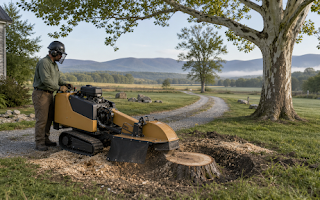
Most people want the stump gone for one of three reasons: they want to mow over it, they want to plant something there, or they are tired of looking at it.
All three are good reasons. Grinding handles all three.
What we need to know first is what is underground. Water lines, septic, electric, irrigation, invisible fence. We call for utility marking on anything we are not sure about. A grinder does not stop for a water line, so this step is not optional.
Limestone with karst features and river silt on the bottoms means we plan the depth around what the ground will give us.
The tree coming down is the easy part. Everything around it is what takes planning.
We put plywood down over driveways where heavy equipment runs. We use mats on soft lawn. We move or protect anything in the drop zone before a saw starts.
On tight lots in Quicksburg, we rope pieces down rather than dropping them. It takes longer and it is the only way to guarantee nothing lands where it should not.
Four steps, every time:
No surprises added halfway through. If something unexpected comes up, we stop and talk to you before it costs you anything.
From Shenandoah Caverns and the nearby river bottom out to Mount Jackson, New Market, and Edinburg, we work the whole area regularly.
Residential, farm, commercial, HOA. Single trees and whole lots.
If you have several properties in the area, we can look at all of them in one visit and quote them together, which usually costs less than handling them separately.
We remove trees of any size, from a dead silver maple beside the driveway to a full-grown sycamore hanging over the roof.
What is included every time:
You should not be able to tell we were there, except for the missing tree.
Here is what to do first, in order:
River bottom flooding softens ground under the biggest trees, so this is a routine we walk Quicksburg property owners through more often than we would like.
A well-pruned tree does not look pruned. It just looks healthy.
That is the goal. Not a shaped hedge, not a bare pole, just a tree with its weight balanced and its dead wood gone.
Clearance pruning is the other half of what we do. Limbs over the roof drop debris into gutters and hold moisture against shingles. Limbs over the driveway scrape vehicles. Limbs into the power drop are a utility problem and a fire risk.
None of that requires taking the tree down. It requires the right cuts in the right places.
Losing a mature tree changes a yard. More sun, less shelter, different drainage.
If you are replanting in Quicksburg, match the tree to the spot. Small ornamental near the house. Large shade tree well out from the foundation, ideally thirty feet or more.
Give the new tree room to reach full size. The mistake almost everyone makes is planting something that looks proportional today and will be pressed against the siding in twenty years.
Do you handle small jobs?
Yes. One limb over a driveway counts.
Do you do farms and large acreage?
Yes, and we would rather walk the whole property once than come back four times.
What if the tree is on a slope?
It changes the rigging plan and sometimes the equipment. It does not stop the job.
Do you clean up?
Always. Raked, not just picked over.
Send us photos or book a walk-through. We will look at the tree, explain the options, and give you a written quote.
Quicksburg property owners, we are close by and we answer the phone.


.jpg)


