

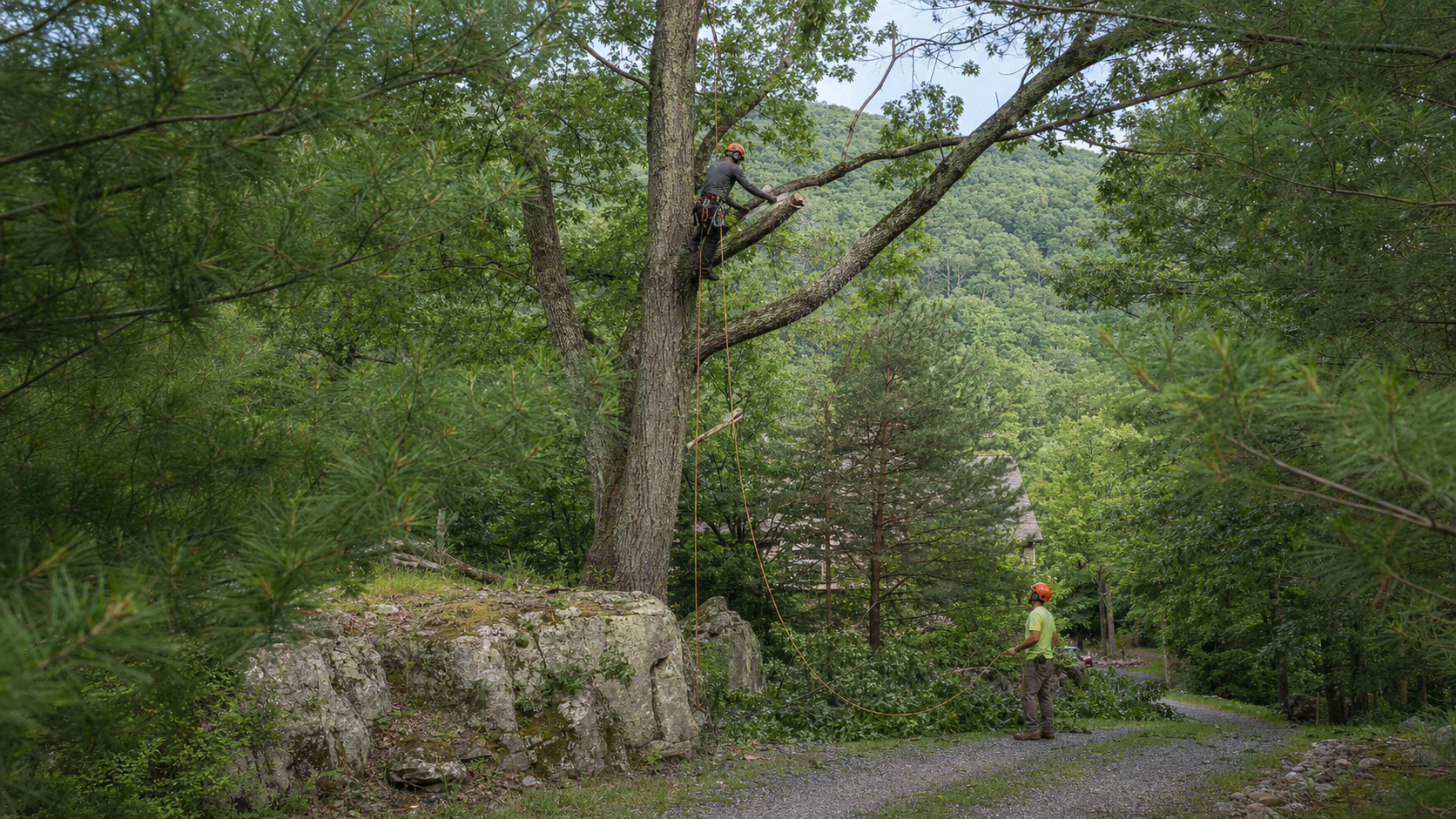
Working in McGaheysville means working around Resort Drive, Route 33, and the country roads toward Penn Laird, and around larger lots with a lot of standing woods left in place.
That sounds like a small detail. It is not. Access decides how a tree comes down, how long it takes, and what it costs.
Below: how we handle removal, pruning and stump grinding here, and what makes McGaheysville its own job.
Two trees the same height can differ a lot in price.
The one in the middle of a pasture gets felled in one cut. The one wedged between a house and a power line comes down in twenty pieces, each one roped and lowered.
Same tree, very different job.
In McGaheysville, access is often the deciding factor. Narrow drives, gates, soft ground and steep lots all change what equipment we can use.
We would rather explain that up front than surprise you with it later.
Losing a mature tree changes a yard. More sun, less shelter, different drainage.
If you are replanting in McGaheysville, match the tree to the spot. Small ornamental near the house. Large shade tree well out from the foundation, ideally thirty feet or more.
Give the new tree room to reach full size. The mistake almost everyone makes is planting something that looks proportional today and will be pressed against the siding in twenty years.
A well-pruned tree does not look pruned. It just looks healthy.
That is the goal. Not a shaped hedge, not a bare pole, just a tree with its weight balanced and its dead wood gone.
Clearance pruning is the other half of what we do. Limbs over the roof drop debris into gutters and hold moisture against shingles. Limbs over the driveway scrape vehicles. Limbs into the power drop are a utility problem and a fire risk.
None of that requires taking the tree down. It requires the right cuts in the right places.
Winter is our quieter season, and that works in your favor.
Frozen or firm ground means equipment can get places it cannot reach in spring mud. Bare canopies make assessment easier. And scheduling is more flexible.
The busiest stretch is right after summer storms, when everybody calls at once. If you already know a tree needs to come down, dealing with it in January beats competing for a slot in July.
Can you save my tree instead of removing it?
Often, yes. We will tell you honestly either way.
What about the neighbor's tree hanging over my yard?
In Virginia you can generally trim back to the property line, but not enough to kill the tree. Talking to the neighbor first saves a lot of trouble.
Does insurance cover this?
Usually only if the tree has hit a structure. A tree that fell in the yard is normally on you.
How soon can you come?
Emergencies same or next day. Normal work is scheduled.
Wind and ice damage trees differently.
Wind pushes. It takes trees over at the roots when the ground is soft, or snaps trunks where there is already decay inside.
Ice loads. A quarter inch of ice can add hundreds of pounds to a single limb. Trees with wide horizontal branching, like white oak, take the worst of it.
In McGaheysville, downhill wind funnels through the hollows and hits pines hardest. Both kinds of damage show up here.
Roots do not go as deep as people think. Most of a tree's root system sits in the top eighteen inches of soil, spreading out well past the canopy edge.
Around McGaheysville the soil is rocky foothill soil with limestone outcrops. That controls how well a tree anchors itself.
Half the properties here have a wooded back half that has never been thinned.
It also matters for stump grinding, because rock and compaction both slow the work down.
Most people want the stump gone for one of three reasons: they want to mow over it, they want to plant something there, or they are tired of looking at it.
All three are good reasons. Grinding handles all three.
What we need to know first is what is underground. Water lines, septic, electric, irrigation, invisible fence. We call for utility marking on anything we are not sure about. A grinder does not stop for a water line, so this step is not optional.
Rocky foothill soil with limestone outcrops means we plan the depth around what the ground will give us.
From the Massanutten foothills and Route 33 out to Massanutten, Penn Laird, and Elkton, we work the whole area regularly.
Residential, farm, commercial, HOA. Single trees and whole lots.
If you have several properties in the area, we can look at all of them in one visit and quote them together, which usually costs less than handling them separately.
We remove trees of any size, from a dead black walnut beside the driveway to a full-grown red maple hanging over the roof.
What is included every time:
You should not be able to tell we were there, except for the missing tree.
Ask any tree company for two documents: general liability and workers compensation.
Here is why the second one matters to you. If an uninsured worker is hurt on your property, you can end up responsible. Your homeowners policy may not cover it.
We carry both, and we will hand you the certificates before we start.
This matters most after storms, when out-of-area crews show up around McGaheysville looking for cash work. Some are legitimate. Many are not.
Walk your property once a year and look for these:
Any one of these is worth a look. Two or more together usually means the tree is in trouble.
The tree mix in McGaheysville runs heavily toward red maple, white oak and black walnut, with Virginia pine and shagbark hickory filling in.
Two of these are worth flagging.
Ash of any kind in this region is either dead or dying from emerald ash borer. If you have standing ash, assume it is on the clock.
Anything with multiple trunks joined at the base is a candidate for splitting, whatever the species. That is a structure problem, not a health problem, and it is worth having looked at.
Send us photos or book a walk-through. We will look at the tree, explain the options, and give you a written quote.
McGaheysville property owners, we are close by and we answer the phone.


.jpg)


