

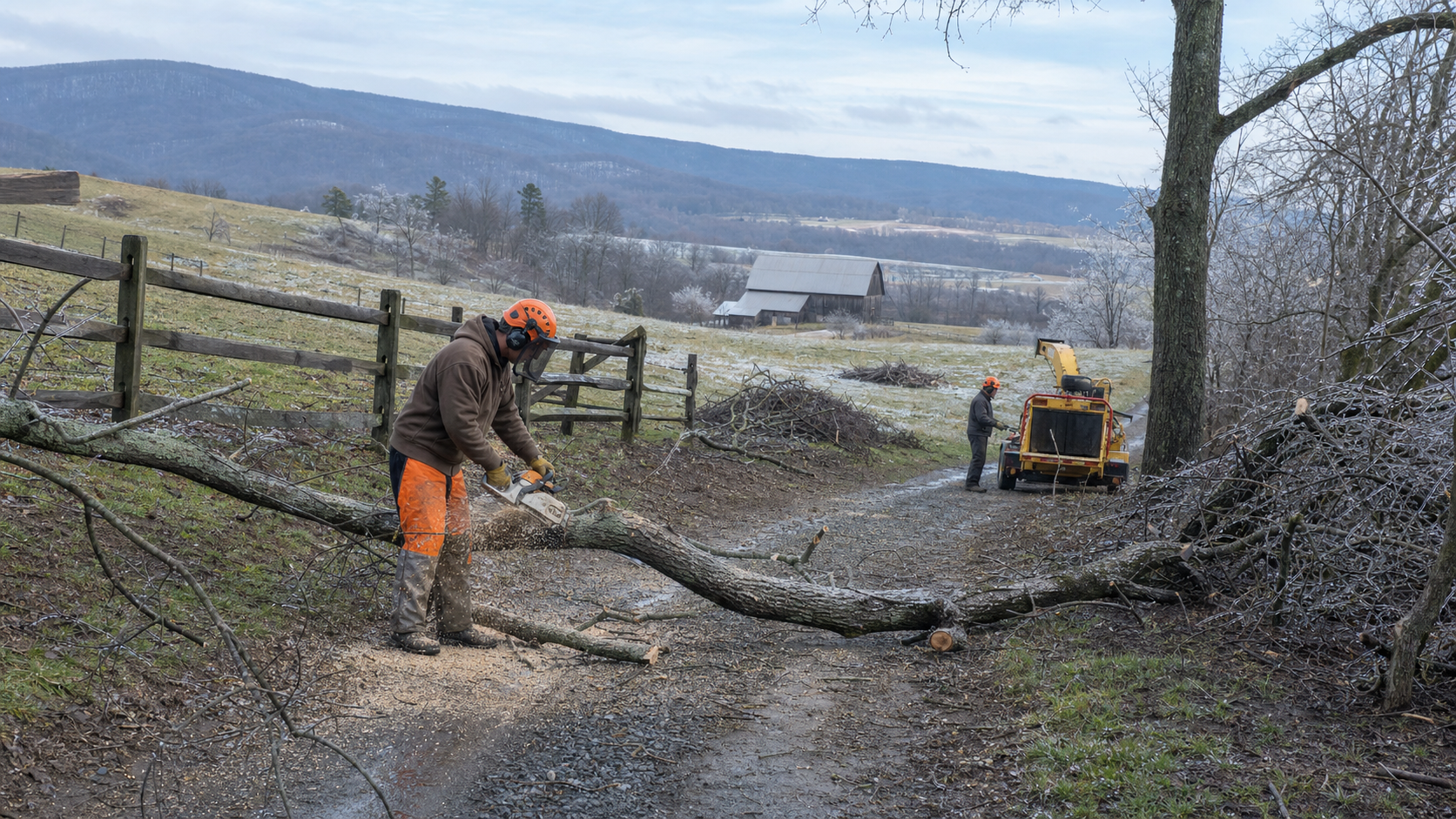
Timberville sits on rolling farm country along the North Fork with Great North Mountain to the west.
That one fact drives most of the tree work we do here. Black walnuts are everywhere here, and the wood is heavy enough that a failed limb does real damage.
We remove trees, prune them, and grind out the stumps left behind. This page explains how each of those works on Timberville properties, and what makes this area different from the next town over.
Here is what to do first, in order:
Ice storms load up the locust and walnut until limbs let go, so this is a routine we walk Timberville property owners through more often than we would like.
The tree coming down is the easy part. Everything around it is what takes planning.
We put plywood down over driveways where heavy equipment runs. We use mats on soft lawn. We move or protect anything in the drop zone before a saw starts.
On tight lots in Timberville, we rope pieces down rather than dropping them. It takes longer and it is the only way to guarantee nothing lands where it should not.
Our regular route covers Timberville, plus Broadway, Fulks Run, and Mount Jackson.
Being local matters for two reasons. We can get to an emergency quickly, and we already know the ground, the access issues along Route 42, Main Street, and the farm lanes off Turleytown Road, and what grows where.
We are not a crew driving in from three counties over after a storm.
Two trees the same height can differ a lot in price.
The one in the middle of a pasture gets felled in one cut. The one wedged between a house and a power line comes down in twenty pieces, each one roped and lowered.
Same tree, very different job.
In Timberville, access is often the deciding factor. Narrow drives, gates, soft ground and steep lots all change what equipment we can use.
We would rather explain that up front than surprise you with it later.
A removal leaves a gap. Worth thinking about what goes there.
If you grind the stump, wait before replanting in the exact spot. The chips left behind pull nitrogen out of the soil as they break down, which starves a young tree. Either haul the chips and backfill with topsoil, or plant a few feet away.
Also worth doing: pick a species that fits the space at full size, not at nursery size. Most tree problems start as a planting decision made thirty years earlier.
Healthy mature trees add value. Dangerous ones subtract it.
A buyer walking a property notices a dead tree over the roofline, and their inspector will note it. It becomes a negotiating point, and the number they knock off is usually more than the removal would have cost.
The reverse is also true. A well-kept canopy is one of the first things people notice about a property, and it is not something a new owner can create quickly.
Not every tree issue is urgent. These are:
If you are in Timberville and any of these describe a tree on your property, do not wait for the next storm to decide for you.
Trees in yards grow differently than trees in forests.
In the woods, competition forces a tree to grow straight up with a single strong trunk. In an open yard, the same species spreads wide and often splits into two or three trunks. Those splits are where trees break.
Pruning early corrects that. A young white oak shaped properly at ten years old will not need an emergency call at forty.
If your trees are already mature, we work with what is there. Reduce the heavy ends, clear the dead, take pressure off the weak unions.
Not every ugly tree is a dangerous tree. And not every healthy-looking tree is safe.
We look at three things before recommending removal: the condition of the trunk, the amount of dead wood in the canopy, and what is underneath it.
A hollow black walnut in the middle of a pasture can stand for years. The same tree twelve feet from a bedroom wall is a different conversation entirely.
If we think a tree can be saved with pruning, we will tell you that. We would rather do a smaller job and keep your business than sell you a removal you did not need.
Cutting a tree down leaves a stump. Grinding it out is a separate job, and it is worth doing.
Left alone, a stump attracts carpenter ants and termites, sends up shoots you have to keep cutting, and sits there as a mowing obstacle for years. Hardwood stumps can take a decade or more to rot on their own.
Our grinder takes it down six to twelve inches below grade. You get a hole full of wood chips, which you can leave, use as mulch, or replace with topsoil and seed.
Ground here is clay-heavy uplands that stay wet through the spring, which affects how deep we can go and how fast the work moves.
How long does a removal take?
Most take half a day. Big or awkward ones take a full day.
Do I need to be home?
No, as long as we have talked through the plan and access is sorted.
Will the lawn be damaged?
We use mats and plywood on soft ground. Some rutting is possible after heavy rain, and we will tell you if that is likely.
Do you take the stump too?
Only if you ask. It is a separate service, and we will quote it alongside the removal.
We arrive, walk the site with you, and confirm the plan before anything starts.
Then we set up. That means protecting the lawn, moving what needs moving, and setting rigging points if the tree cannot be dropped in one piece.
The cutting is usually the shortest part. Cleanup takes longer than people expect, because doing it properly means raking, not just picking up the big pieces.
Before we leave, we walk the site with you again.
Removal, pruning, stump grinding. Timberville and everywhere around it.
Send a photo or give us a call. We will tell you what we think, and we will tell you if you do not need us.


.jpg)


