

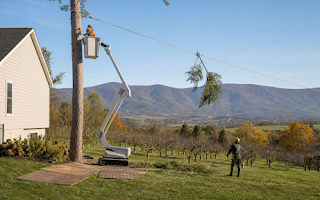
Working in Stuarts Draft means working around Route 340, Tinkling Spring Road, and the subdivisions off Stuarts Draft Highway, and around fast-growing subdivisions mixed with older farm and orchard land.
That sounds like a small detail. It is not. Access decides how a tree comes down, how long it takes, and what it costs.
Below: how we handle removal, pruning and stump grinding here, and what makes Stuarts Draft its own job.
The tree coming down is the easy part. Everything around it is what takes planning.
We put plywood down over driveways where heavy equipment runs. We use mats on soft lawn. We move or protect anything in the drop zone before a saw starts.
On tight lots in Stuarts Draft, we rope pieces down rather than dropping them. It takes longer and it is the only way to guarantee nothing lands where it should not.
We remove trees of any size, from a dead red maple beside the driveway to a full-grown Virginia pine hanging over the roof.
What is included every time:
You should not be able to tell we were there, except for the missing tree.
You can learn a lot about a tree before you ever touch it, just from where it is standing.
In Stuarts Draft, the terrain is gently rolling ground on the Blue Ridge side of the valley and the soil runs sandy, well-drained ground that pines took over quickly. Trees adapt to that. A tree grown in soft river bottom builds a different root system than the same species on a rocky slope.
A lot of yards here still have orchard trees that were never meant to grow to full size.
That shapes how it fails, and how we plan the work.
Most people want the stump gone for one of three reasons: they want to mow over it, they want to plant something there, or they are tired of looking at it.
All three are good reasons. Grinding handles all three.
What we need to know first is what is underground. Water lines, septic, electric, irrigation, invisible fence. We call for utility marking on anything we are not sure about. A grinder does not stop for a water line, so this step is not optional.
Sandy, well-drained ground that pines took over quickly means we plan the depth around what the ground will give us.
Not every tree issue is urgent. These are:
If you are in Stuarts Draft and any of these describe a tree on your property, do not wait for the next storm to decide for you.
A removal leaves a gap. Worth thinking about what goes there.
If you grind the stump, wait before replanting in the exact spot. The chips left behind pull nitrogen out of the soil as they break down, which starves a young tree. Either haul the chips and backfill with topsoil, or plant a few feet away.
Also worth doing: pick a species that fits the space at full size, not at nursery size. Most tree problems start as a planting decision made thirty years earlier.
Healthy mature trees add value. Dangerous ones subtract it.
A buyer walking a property notices a dead tree over the roofline, and their inspector will note it. It becomes a negotiating point, and the number they knock off is usually more than the removal would have cost.
The reverse is also true. A well-kept canopy is one of the first things people notice about a property, and it is not something a new owner can create quickly.
Here is what to do first, in order:
Pines here snap partway up rather than uprooting, so this is a routine we walk Stuarts Draft property owners through more often than we would like.
A well-pruned tree does not look pruned. It just looks healthy.
That is the goal. Not a shaped hedge, not a bare pole, just a tree with its weight balanced and its dead wood gone.
Clearance pruning is the other half of what we do. Limbs over the roof drop debris into gutters and hold moisture against shingles. Limbs over the driveway scrape vehicles. Limbs into the power drop are a utility problem and a fire risk.
None of that requires taking the tree down. It requires the right cuts in the right places.
Four steps, every time:
No surprises added halfway through. If something unexpected comes up, we stop and talk to you before it costs you anything.
Anyone who quotes you a price over the phone without seeing the tree is guessing.
Here is what actually moves the number:
Leaving the logs on site can bring the price down noticeably if you burn wood.
Winter is our quieter season, and that works in your favor.
Frozen or firm ground means equipment can get places it cannot reach in spring mud. Bare canopies make assessment easier. And scheduling is more flexible.
The busiest stretch is right after summer storms, when everybody calls at once. If you already know a tree needs to come down, dealing with it in January beats competing for a slot in July.
Send us photos or book a walk-through. We will look at the tree, explain the options, and give you a written quote.
Stuarts Draft property owners, we are close by and we answer the phone.


.jpg)


