

Trees in Shenandoah County do not grow the way they do everywhere else. The ground here is a long narrow valley split down the middle by Massanutten Mountain. That shapes what grows, how fast it grows, and how it fails.
Because Massanutten splits the county, the east side and west side get noticeably different weather.
We handle tree removal, pruning and stump grinding for Shenandoah County and the area around the North Fork of the Shenandoah and Massanutten Mountain. Below is what we actually run into here, and what we do about it.
A removal leaves a gap. Worth thinking about what goes there.
If you grind the stump, wait before replanting in the exact spot. The chips left behind pull nitrogen out of the soil as they break down, which starves a young tree. Either haul the chips and backfill with topsoil, or plant a few feet away.
Also worth doing: pick a species that fits the space at full size, not at nursery size. Most tree problems start as a planting decision made thirty years earlier.
Our regular route covers Shenandoah County, plus Frederick County, Warren County, and Rockingham County.
Being local matters for two reasons. We can get to an emergency quickly, and we already know the ground, the access issues along Route 11, Interstate 81, and the farm roads on both sides of the river, and what grows where.
We are not a crew driving in from three counties over after a storm.
Not every tree issue is urgent. These are:
If you are in Shenandoah County and any of these describe a tree on your property, do not wait for the next storm to decide for you.
Two options exist: grinding and full extraction.
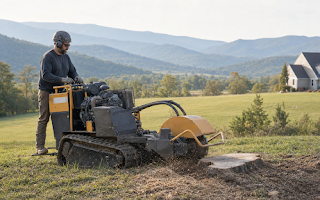
Grinding chews the stump into chips down below ground level. It is fast, it leaves the surrounding lawn intact, and it is what we recommend almost every time.
Full extraction pulls the root ball out with a machine. It leaves a crater, tears up whatever is around it, and costs considerably more. It only makes sense if you are building on the spot.
For a yard in Shenandoah County, grinding is the answer.
Think of pruning as maintenance, not decoration.
What we take out:
What we leave: enough canopy for the tree to feed itself. Take too much and the tree goes into shock. The rule we work by is no more than a quarter of the living canopy in one season.
Black walnut and white oak both respond well to this when it is done at the right time of year.
You can learn a lot about a tree before you ever touch it, just from where it is standing.
In Shenandoah County, the terrain is a long narrow valley split down the middle by Massanutten Mountain and the soil runs limestone valley soil in the middle, thin shale ground up the ridges. Trees adapt to that. A tree grown in soft river bottom builds a different root system than the same species on a rocky slope.
Because Massanutten splits the county, the east side and west side get noticeably different weather.
That shapes how it fails, and how we plan the work.
The tree mix in Shenandoah County runs heavily toward black walnut, white oak and sycamore, with eastern red cedar and silver maple filling in.
Two of these are worth flagging.
Ash of any kind in this region is either dead or dying from emerald ash borer. If you have standing ash, assume it is on the clock.
Anything with multiple trunks joined at the base is a candidate for splitting, whatever the species. That is a structure problem, not a health problem, and it is worth having looked at.
Removal is the last option, not the first. But when a tree is dead, split, or leaning toward something you care about, waiting only makes it more expensive.
Here is when we say take it down:
On Shenandoah County properties we see this most with black walnut and white oak. Both grow fast, and fast growth means weaker wood.
Four steps, every time:
No surprises added halfway through. If something unexpected comes up, we stop and talk to you before it costs you anything.
Do you handle small jobs?
Yes. One limb over a driveway counts.
Do you do farms and large acreage?
Yes, and we would rather walk the whole property once than come back four times.
What if the tree is on a slope?
It changes the rigging plan and sometimes the equipment. It does not stop the job.
Do you clean up?
Always. Raked, not just picked over.
The valley shape funnels wind north to south and it picks up speed doing it.
After a storm, the dangerous work is not the tree that already fell. It is the one that is half down, hung up in another tree, or resting on a roof with all its weight still loaded.
Those are under tension. Cut in the wrong place and the whole thing moves at once.
If you have a tree on a structure or across a driveway in Shenandoah County, call us and stay away from it. Do not try to cut it loose yourself.
If you have a tree in Shenandoah County you are unsure about, we will come look at it and tell you straight whether it needs to go.
No pressure, no charge for the estimate, and a written price before any work starts.


.jpg)


