

If you own property in Keezletown, you already know the trees here get big.
White oak, black locust and hickory all do well in this ground. That is good news for shade and bad news when one of them leans toward your roof.
We work Keezletown regularly, from the properties near Peaked Mountain and the old Keezletown Road out to Penn Laird, Harrisonburg, and Massanutten. Here is how we approach removal, pruning and stump grinding in this specific area.
Most removals in Keezletown cannot be done by just cutting at the base and stepping back.
There is a house, a fence, a power line, or a septic field in the way. So we take the tree down in sections instead, roping each piece to the ground.
It is slower. It is also the difference between a clean job and a repair bill.
Species matters too. A black locust lets go differently than a hickory, and knowing that ahead of time is how you keep the cut piece from swinging where you did not want it.
Our regular route covers Keezletown, plus Penn Laird, Harrisonburg, and Massanutten.
Being local matters for two reasons. We can get to an emergency quickly, and we already know the ground, the access issues along Keezletown Road and the farm lanes running to the ridge, and what grows where.
We are not a crew driving in from three counties over after a storm.
Healthy mature trees add value. Dangerous ones subtract it.
A buyer walking a property notices a dead tree over the roofline, and their inspector will note it. It becomes a negotiating point, and the number they knock off is usually more than the removal would have cost.
The reverse is also true. A well-kept canopy is one of the first things people notice about a property, and it is not something a new owner can create quickly.
Good pruning does two things. It takes out what is already dead, and it shapes what is left so the tree carries its own weight properly.
Done right, it can add decades to a tree's life. Done wrong, it kills it slowly.
The most common mistake we fix in Keezletown is topping. Somebody cuts the top off a tree to make it shorter. The tree responds by throwing up dozens of weak shoots that are attached badly and break easily. Five years later that tree is more dangerous than before it was cut.
We do not top trees. We reduce them properly, back to a growth point that can support the wound.
Wind and ice damage trees differently.
Wind pushes. It takes trees over at the roots when the ground is soft, or snaps trunks where there is already decay inside.
Ice loads. A quarter inch of ice can add hundreds of pounds to a single limb. Trees with wide horizontal branching, like black locust, take the worst of it.
In Keezletown, the ridge blocks some wind but funnels the rest straight down the hollow. Both kinds of damage show up here.
Roots do not go as deep as people think. Most of a tree's root system sits in the top eighteen inches of soil, spreading out well past the canopy edge.
Around Keezletown the soil is shallow soil over shale near the ridge, deeper out on the flats. That controls how well a tree anchors itself.
Old locust fence rows here have grown into full-size trees standing right on property lines.
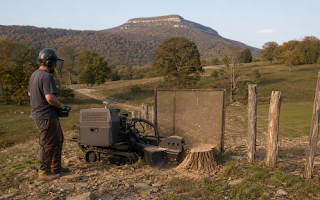
It also matters for stump grinding, because rock and compaction both slow the work down.
A stump is not neutral. It is a slow problem.
Grinding it out takes an hour on most jobs. Living with it takes years.
Walk your property once a year and look for these:
Any one of these is worth a look. Two or more together usually means the tree is in trouble.
Do you handle small jobs?
Yes. One limb over a driveway counts.
Do you do farms and large acreage?
Yes, and we would rather walk the whole property once than come back four times.
What if the tree is on a slope?
It changes the rigging plan and sometimes the equipment. It does not stop the job.
Do you clean up?
Always. Raked, not just picked over.
A removal leaves a gap. Worth thinking about what goes there.
If you grind the stump, wait before replanting in the exact spot. The chips left behind pull nitrogen out of the soil as they break down, which starves a young tree. Either haul the chips and backfill with topsoil, or plant a few feet away.
Also worth doing: pick a species that fits the space at full size, not at nursery size. Most tree problems start as a planting decision made thirty years earlier.
It starts with a phone call and ends with a clean yard.
In between: an on-site look, a written quote, a scheduled date, and the work itself. We will tell you roughly how long it will take and whether you need to move vehicles.
We are licensed and insured, and we will show you the certificate without being asked. If a tree company will not show you proof of insurance, that is your answer about whether to hire them.
Winter is our quieter season, and that works in your favor.
Frozen or firm ground means equipment can get places it cannot reach in spring mud. Bare canopies make assessment easier. And scheduling is more flexible.
The busiest stretch is right after summer storms, when everybody calls at once. If you already know a tree needs to come down, dealing with it in January beats competing for a slot in July.
Tree removal is only part of what we do here, though it is what most people call about.
Most people call after a tree becomes a problem. It is cheaper to call before.
Either way, we are here. Serving Keezletown and the surrounding area with honest estimates and clean work.


.jpg)


