

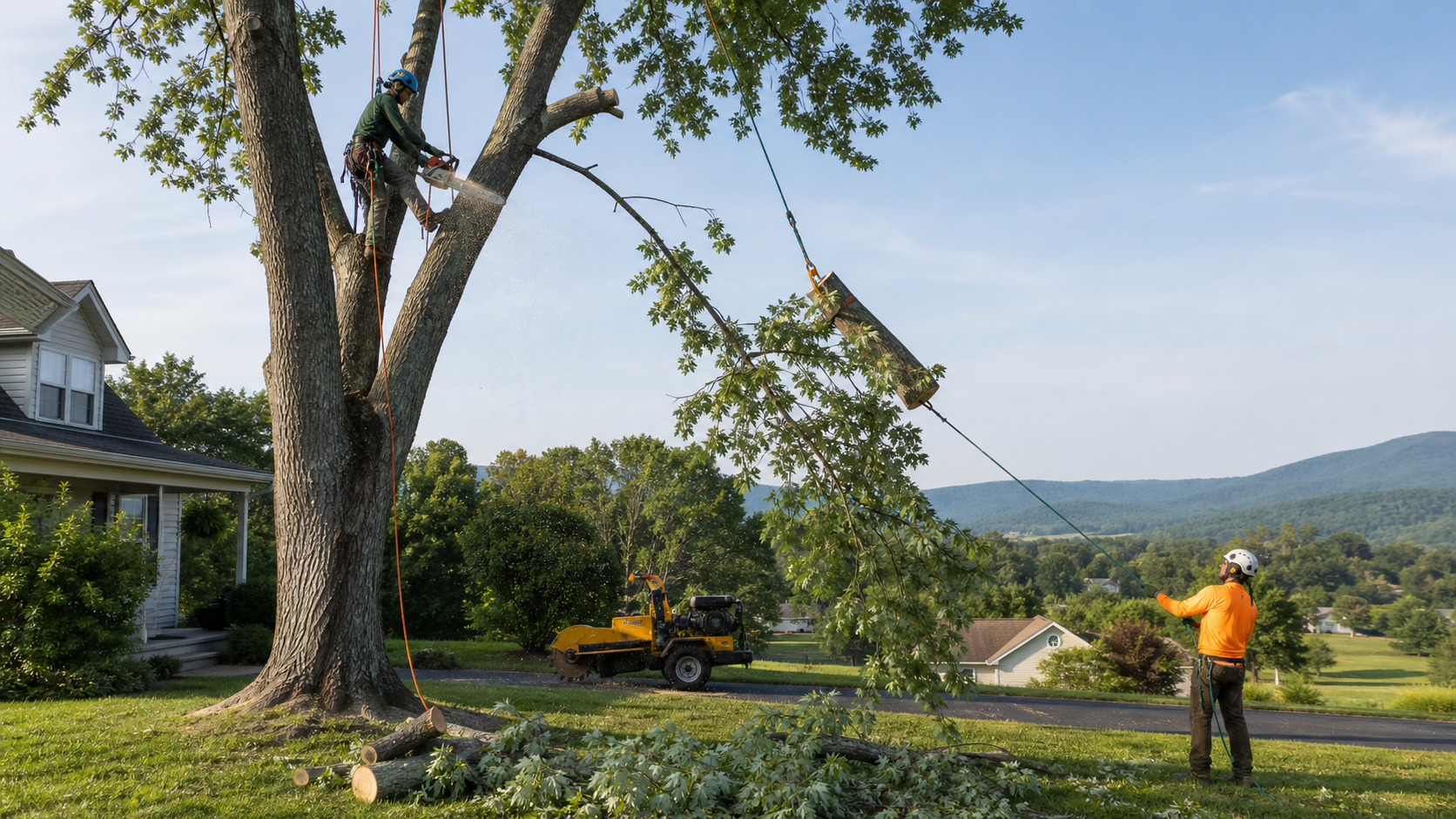
Trees in Harrisonburg do not grow the way they do everywhere else. The ground here is a bowl of gentle hills with Massanutten Ridge on one side and the Alleghenies on the other. That shapes what grows, how fast it grows, and how it fails.
A lot of the street trees here were planted in the same decade, which means whole blocks are aging out at once.
We handle tree removal, pruning and stump grinding for Harrisonburg and the area around the JMU campus and Court Square. Below is what we actually run into here, and what we do about it.
Two options exist: grinding and full extraction.
Grinding chews the stump into chips down below ground level. It is fast, it leaves the surrounding lawn intact, and it is what we recommend almost every time.
Full extraction pulls the root ball out with a machine. It leaves a crater, tears up whatever is around it, and costs considerably more. It only makes sense if you are building on the spot.
For a yard in Harrisonburg, grinding is the answer.
A removal leaves a gap. Worth thinking about what goes there.
If you grind the stump, wait before replanting in the exact spot. The chips left behind pull nitrogen out of the soil as they break down, which starves a young tree. Either haul the chips and backfill with topsoil, or plant a few feet away.
Also worth doing: pick a species that fits the space at full size, not at nursery size. Most tree problems start as a planting decision made thirty years earlier.
Two trees the same height can differ a lot in price.
The one in the middle of a pasture gets felled in one cut. The one wedged between a house and a power line comes down in twenty pieces, each one roped and lowered.
Same tree, very different job.
In Harrisonburg, access is often the deciding factor. Narrow drives, gates, soft ground and steep lots all change what equipment we can use.
We would rather explain that up front than surprise you with it later.
Roots do not go as deep as people think. Most of a tree's root system sits in the top eighteen inches of soil, spreading out well past the canopy edge.
Around Harrisonburg the soil is deep limestone-based loam that holds roots well until it gets waterlogged. That controls how well a tree anchors itself.
A lot of the street trees here were planted in the same decade, which means whole blocks are aging out at once.
It also matters for stump grinding, because rock and compaction both slow the work down.
The honest answer is that the best time to deal with a dangerous tree is now.
That said, if there is no urgency, here is the ideal calendar:
Wind and ice damage trees differently.
Wind pushes. It takes trees over at the roots when the ground is soft, or snaps trunks where there is already decay inside.
Ice loads. A quarter inch of ice can add hundreds of pounds to a single limb. Trees with wide horizontal branching, like pin oak, take the worst of it.
In Harrisonburg, summer thunderstorms roll in off the ridge and hit the city hard. Both kinds of damage show up here.
Think of pruning as maintenance, not decoration.
What we take out:
What we leave: enough canopy for the tree to feed itself. Take too much and the tree goes into shock. The rule we work by is no more than a quarter of the living canopy in one season.
Silver maple and pin oak both respond well to this when it is done at the right time of year.
Our regular route covers Harrisonburg, plus Dayton, Bridgewater, and Penn Laird.
Being local matters for two reasons. We can get to an emergency quickly, and we already know the ground, the access issues along Port Republic Road, South Main, and the neighborhoods off Reservoir Street, and what grows where.
We are not a crew driving in from three counties over after a storm.
Removal is the last option, not the first. But when a tree is dead, split, or leaning toward something you care about, waiting only makes it more expensive.
Here is when we say take it down:
On Harrisonburg properties we see this most with silver maple and pin oak. Both grow fast, and fast growth means weaker wood.
Ask any tree company for two documents: general liability and workers compensation.
Here is why the second one matters to you. If an uninsured worker is hurt on your property, you can end up responsible. Your homeowners policy may not cover it.
We carry both, and we will hand you the certificates before we start.
This matters most after storms, when out-of-area crews show up around Harrisonburg looking for cash work. Some are legitimate. Many are not.
How long does a removal take?
Most take half a day. Big or awkward ones take a full day.
Do I need to be home?
No, as long as we have talked through the plan and access is sorted.
Will the lawn be damaged?
We use mats and plywood on soft ground. Some rutting is possible after heavy rain, and we will tell you if that is likely.
Do you take the stump too?
Only if you ask. It is a separate service, and we will quote it alongside the removal.
You can learn most of what you need from the ground.
Stand back far enough to see the whole tree. Is the canopy full and even, or is one side thin? Are there bare branches sticking up above the leaves?
Then walk up to the base. Look for fungus, loose bark, and soil that looks disturbed or lifted.
Then walk a circle around it and look up. Broken limbs caught in the canopy are common and easy to spot once you are looking for them.
That five-minute check catches most serious problems.
If you have a tree in Harrisonburg you are unsure about, we will come look at it and tell you straight whether it needs to go.
No pressure, no charge for the estimate, and a written price before any work starts.


.jpg)


