

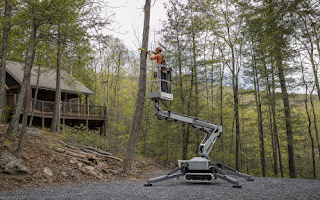
Basye sits on a mountain resort area up on the western slope near Bryce.
That one fact drives most of the tree work we do here. Hemlock woolly adelgid has weakened a lot of the hemlocks on these slopes.
We remove trees, prune them, and grind out the stumps left behind. This page explains how each of those works on Basye properties, and what makes this area different from the next town over.
Ask any tree company for two documents: general liability and workers compensation.
Here is why the second one matters to you. If an uninsured worker is hurt on your property, you can end up responsible. Your homeowners policy may not cover it.
We carry both, and we will hand you the certificates before we start.
This matters most after storms, when out-of-area crews show up around Basye looking for cash work. Some are legitimate. Many are not.
Trees in yards grow differently than trees in forests.
In the woods, competition forces a tree to grow straight up with a single strong trunk. In an open yard, the same species spreads wide and often splits into two or three trunks. Those splits are where trees break.
Pruning early corrects that. A young eastern hemlock shaped properly at ten years old will not need an emergency call at forty.
If your trees are already mature, we work with what is there. Reduce the heavy ends, clear the dead, take pressure off the weak unions.
Our regular route covers Basye, plus Orkney Springs, Mount Jackson, and Fort Valley.
Being local matters for two reasons. We can get to an emergency quickly, and we already know the ground, the access issues along Bryce Boulevard and the steep lanes off Supin Lick Road, and what grows where.
We are not a crew driving in from three counties over after a storm.
Walk your property once a year and look for these:
Any one of these is worth a look. Two or more together usually means the tree is in trouble.
Wind and ice damage trees differently.
Wind pushes. It takes trees over at the roots when the ground is soft, or snaps trunks where there is already decay inside.
Ice loads. A quarter inch of ice can add hundreds of pounds to a single limb. Trees with wide horizontal branching, like white pine, take the worst of it.
In Basye, ice at elevation loads limbs far heavier than down in the valley. Both kinds of damage show up here.
Not every ugly tree is a dangerous tree. And not every healthy-looking tree is safe.
We look at three things before recommending removal: the condition of the trunk, the amount of dead wood in the canopy, and what is underneath it.
A hollow chestnut oak in the middle of a pasture can stand for years. The same tree twelve feet from a bedroom wall is a different conversation entirely.
If we think a tree can be saved with pruning, we will tell you that. We would rather do a smaller job and keep your business than sell you a removal you did not need.
Do you handle small jobs?
Yes. One limb over a driveway counts.
Do you do farms and large acreage?
Yes, and we would rather walk the whole property once than come back four times.
What if the tree is on a slope?
It changes the rigging plan and sometimes the equipment. It does not stop the job.
Do you clean up?
Always. Raked, not just picked over.
A removal leaves a gap. Worth thinking about what goes there.
If you grind the stump, wait before replanting in the exact spot. The chips left behind pull nitrogen out of the soil as they break down, which starves a young tree. Either haul the chips and backfill with topsoil, or plant a few feet away.
Also worth doing: pick a species that fits the space at full size, not at nursery size. Most tree problems start as a planting decision made thirty years earlier.
The tree mix in Basye runs heavily toward chestnut oak, white pine and eastern hemlock, with black gum and red maple filling in.
Two of these are worth flagging.
Ash of any kind in this region is either dead or dying from emerald ash borer. If you have standing ash, assume it is on the clock.
Anything with multiple trunks joined at the base is a candidate for splitting, whatever the species. That is a structure problem, not a health problem, and it is worth having looked at.
Cutting a tree down leaves a stump. Grinding it out is a separate job, and it is worth doing.
Left alone, a stump attracts carpenter ants and termites, sends up shoots you have to keep cutting, and sits there as a mowing obstacle for years. Hardwood stumps can take a decade or more to rot on their own.
Our grinder takes it down six to twelve inches below grade. You get a hole full of wood chips, which you can leave, use as mulch, or replace with topsoil and seed.
Ground here is thin rocky mountain soil that gives shallow root plates, which affects how deep we can go and how fast the work moves.
Tree work is priced on risk and time, not on the tree.
Risk means what happens if something goes wrong. A tree over an open lawn carries almost none. A tree over a roof carries a lot, and that is reflected in the price.
Time means setup, cutting, and cleanup. Cleanup is often half the day.
Ways to bring it down: keep the wood, keep the chips, or bundle several trees into one visit. Mobilizing the crew once for four trees costs far less than four separate trips.
Winter is our quieter season, and that works in your favor.
Frozen or firm ground means equipment can get places it cannot reach in spring mud. Bare canopies make assessment easier. And scheduling is more flexible.
The busiest stretch is right after summer storms, when everybody calls at once. If you already know a tree needs to come down, dealing with it in January beats competing for a slot in July.
Removal, pruning, stump grinding. Basye and everywhere around it.
Send a photo or give us a call. We will tell you what we think, and we will tell you if you do not need us.


.jpg)


