

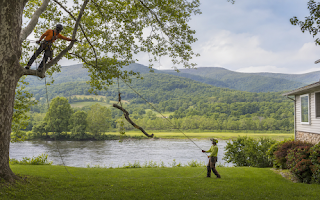
Waynesboro sits on flat ground along the South River right at the foot of the Blue Ridge.
That one fact drives most of the tree work we do here. The 2020 river work changed drainage in several neighborhoods, and some old trees have not adjusted well.
We remove trees, prune them, and grind out the stumps left behind. This page explains how each of those works on Waynesboro properties, and what makes this area different from the next town over.
The tree mix in Waynesboro runs heavily toward sycamore, silver maple and red oak, with river birch and tulip poplar filling in.
Two of these are worth flagging.
Ash of any kind in this region is either dead or dying from emerald ash borer. If you have standing ash, assume it is on the clock.
Anything with multiple trunks joined at the base is a candidate for splitting, whatever the species. That is a structure problem, not a health problem, and it is worth having looked at.
It starts with a phone call and ends with a clean yard.
In between: an on-site look, a written quote, a scheduled date, and the work itself. We will tell you roughly how long it will take and whether you need to move vehicles.
We are licensed and insured, and we will show you the certificate without being asked. If a tree company will not show you proof of insurance, that is your answer about whether to hire them.
Cutting a tree down leaves a stump. Grinding it out is a separate job, and it is worth doing.
Left alone, a stump attracts carpenter ants and termites, sends up shoots you have to keep cutting, and sits there as a mowing obstacle for years. Hardwood stumps can take a decade or more to rot on their own.
Our grinder takes it down six to twelve inches below grade. You get a hole full of wood chips, which you can leave, use as mulch, or replace with topsoil and seed.
Ground here is river-bottom soil in town, rockier ground as you climb toward the gap, which affects how deep we can go and how fast the work moves.
We cover Waynesboro and everything nearby, including Fishersville, Crimora, and Lyndhurst.
That means the properties around the South River Greenway and Rockfish Gap, along Main Street, Rosser Avenue, and the neighborhoods along the river, and out on the rural parcels past them.
If you are not sure whether you are in our area, just ask. We are usually working somewhere close by already.
Two trees the same height can differ a lot in price.
The one in the middle of a pasture gets felled in one cut. The one wedged between a house and a power line comes down in twenty pieces, each one roped and lowered.
Same tree, very different job.
In Waynesboro, access is often the deciding factor. Narrow drives, gates, soft ground and steep lots all change what equipment we can use.
We would rather explain that up front than surprise you with it later.
Ask any tree company for two documents: general liability and workers compensation.
Here is why the second one matters to you. If an uninsured worker is hurt on your property, you can end up responsible. Your homeowners policy may not cover it.
We carry both, and we will hand you the certificates before we start.
This matters most after storms, when out-of-area crews show up around Waynesboro looking for cash work. Some are legitimate. Many are not.
Roots do not go as deep as people think. Most of a tree's root system sits in the top eighteen inches of soil, spreading out well past the canopy edge.
Around Waynesboro the soil is river-bottom soil in town, rockier ground as you climb toward the gap. That controls how well a tree anchors itself.
The 2020 river work changed drainage in several neighborhoods, and some old trees have not adjusted well.
It also matters for stump grinding, because rock and compaction both slow the work down.
You have options, and they affect the price.
Tell us what you want before we start and we will price it that way.
Not every ugly tree is a dangerous tree. And not every healthy-looking tree is safe.
We look at three things before recommending removal: the condition of the trunk, the amount of dead wood in the canopy, and what is underneath it.
A hollow sycamore in the middle of a pasture can stand for years. The same tree twelve feet from a bedroom wall is a different conversation entirely.
If we think a tree can be saved with pruning, we will tell you that. We would rather do a smaller job and keep your business than sell you a removal you did not need.
Wind and ice damage trees differently.
Wind pushes. It takes trees over at the roots when the ground is soft, or snaps trunks where there is already decay inside.
Ice loads. A quarter inch of ice can add hundreds of pounds to a single limb. Trees with wide horizontal branching, like silver maple, take the worst of it.
In Waynesboro, rockfish gap funnels mountain wind straight into town. Both kinds of damage show up here.
Trees in yards grow differently than trees in forests.
In the woods, competition forces a tree to grow straight up with a single strong trunk. In an open yard, the same species spreads wide and often splits into two or three trunks. Those splits are where trees break.
Pruning early corrects that. A young red oak shaped properly at ten years old will not need an emergency call at forty.
If your trees are already mature, we work with what is there. Reduce the heavy ends, clear the dead, take pressure off the weak unions.
Can you save my tree instead of removing it?
Often, yes. We will tell you honestly either way.
What about the neighbor's tree hanging over my yard?
In Virginia you can generally trim back to the property line, but not enough to kill the tree. Talking to the neighbor first saves a lot of trouble.
Does insurance cover this?
Usually only if the tree has hit a structure. A tree that fell in the yard is normally on you.
How soon can you come?
Emergencies same or next day. Normal work is scheduled.
Removal, pruning, stump grinding. Waynesboro and everywhere around it.
Send a photo or give us a call. We will tell you what we think, and we will tell you if you do not need us.


.jpg)


