

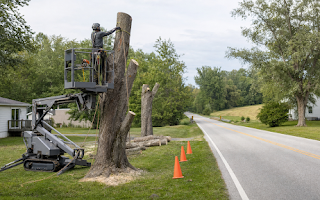
Trees in Toms Brook do not grow the way they do everywhere else. The ground here is a very small town on flat ground along Tumbling Run. That shapes what grows, how fast it grows, and how it fails.
It is a small enough place that one failed tree can block the main road through town.
We handle tree removal, pruning and stump grinding for Toms Brook and the area around Tumbling Run and the Route 11 corridor. Below is what we actually run into here, and what we do about it.
Two options exist: grinding and full extraction.
Grinding chews the stump into chips down below ground level. It is fast, it leaves the surrounding lawn intact, and it is what we recommend almost every time.
Full extraction pulls the root ball out with a machine. It leaves a crater, tears up whatever is around it, and costs considerably more. It only makes sense if you are building on the spot.
For a yard in Toms Brook, grinding is the answer.
Roots do not go as deep as people think. Most of a tree's root system sits in the top eighteen inches of soil, spreading out well past the canopy edge.
Around Toms Brook the soil is creek-bottom silt over limestone. That controls how well a tree anchors itself.
It is a small enough place that one failed tree can block the main road through town.
It also matters for stump grinding, because rock and compaction both slow the work down.
Removal is the last option, not the first. But when a tree is dead, split, or leaning toward something you care about, waiting only makes it more expensive.
Here is when we say take it down:
On Toms Brook properties we see this most with silver maple and sycamore. Both grow fast, and fast growth means weaker wood.
The goal is not fewer trees. It is better trees.
Sometimes removing one crowded tree gives the two beside it room to actually thrive. Trees competing for the same light and water all end up weaker than one healthy tree would be.
When we walk a property, we look at the whole picture, not just the tree you called about. If something nearby is a bigger problem, we will say so.
Removal can happen any time. Pruning is more particular.
Late winter is the sweet spot for most hardwoods. No leaves means we can see the structure, the tree is dormant, and cuts seal quickly come spring.
Summer works for light clearance work and dead wood removal.
Fall is the worst time for heavy pruning. The tree is shutting down and wounds stay open longer, right when fungal spores are everywhere.
Dead limbs are the exception. Those come out whenever you notice them.
Two trees the same height can differ a lot in price.
The one in the middle of a pasture gets felled in one cut. The one wedged between a house and a power line comes down in twenty pieces, each one roped and lowered.
Same tree, very different job.
In Toms Brook, access is often the deciding factor. Narrow drives, gates, soft ground and steep lots all change what equipment we can use.
We would rather explain that up front than surprise you with it later.
Ask any tree company for two documents: general liability and workers compensation.
Here is why the second one matters to you. If an uninsured worker is hurt on your property, you can end up responsible. Your homeowners policy may not cover it.
We carry both, and we will hand you the certificates before we start.
This matters most after storms, when out-of-area crews show up around Toms Brook looking for cash work. Some are legitimate. Many are not.
It starts with a phone call and ends with a clean yard.
In between: an on-site look, a written quote, a scheduled date, and the work itself. We will tell you roughly how long it will take and whether you need to move vehicles.
We are licensed and insured, and we will show you the certificate without being asked. If a tree company will not show you proof of insurance, that is your answer about whether to hire them.
You have options, and they affect the price.
Tell us what you want before we start and we will price it that way.
The tree mix in Toms Brook runs heavily toward silver maple, sycamore and black walnut, with boxelder and red maple filling in.
Two of these are worth flagging.
Ash of any kind in this region is either dead or dying from emerald ash borer. If you have standing ash, assume it is on the clock.
Anything with multiple trunks joined at the base is a candidate for splitting, whatever the species. That is a structure problem, not a health problem, and it is worth having looked at.
Think of pruning as maintenance, not decoration.
What we take out:
What we leave: enough canopy for the tree to feed itself. Take too much and the tree goes into shock. The rule we work by is no more than a quarter of the living canopy in one season.
Silver maple and sycamore both respond well to this when it is done at the right time of year.
Storms here do not give much warning. Creek flooding and open-field wind both hit the same trees.
Silver maple is one of the first to show damage, because the wood is not as strong as the tree's size suggests. Big canopy, weak fiber.
We handle emergency removals across Toms Brook and out to Maurertown, Strasburg, and Woodstock. That means cutting a tree off a roof, clearing a blocked drive, or taking down something that survived the storm but will not survive the next one.
If you have a tree in Toms Brook you are unsure about, we will come look at it and tell you straight whether it needs to go.
No pressure, no charge for the estimate, and a written price before any work starts.


.jpg)


