

If you own property in Crimora, you already know the trees here get big.
Red oak, Virginia pine and sycamore all do well in this ground. That is good news for shade and bad news when one of them leans toward your roof.
We work Crimora regularly, from the properties near the old manganese mine ground and Route 340 out to Waynesboro, Grottoes, and Dooms. Here is how we approach removal, pruning and stump grinding in this specific area.
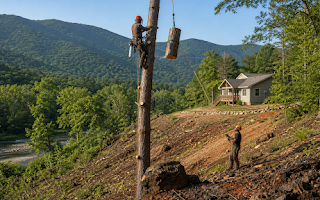
Most removals in Crimora cannot be done by just cutting at the base and stepping back.
There is a house, a fence, a power line, or a septic field in the way. So we take the tree down in sections instead, roping each piece to the ground.
It is slower. It is also the difference between a clean job and a repair bill.
Species matters too. A Virginia pine lets go differently than a sycamore, and knowing that ahead of time is how you keep the cut piece from swinging where you did not want it.
The tree coming down is the easy part. Everything around it is what takes planning.
We put plywood down over driveways where heavy equipment runs. We use mats on soft lawn. We move or protect anything in the drop zone before a saw starts.
On tight lots in Crimora, we rope pieces down rather than dropping them. It takes longer and it is the only way to guarantee nothing lands where it should not.
You can learn a lot about a tree before you ever touch it, just from where it is standing.
In Crimora, the terrain is the foot of the Blue Ridge along the South River and the soil runs disturbed and uneven, with poor root anchorage in the old mine areas. Trees adapt to that. A tree grown in soft river bottom builds a different root system than the same species on a rocky slope.
Old mine ground here left disturbed soil that never packed back down properly.
That shapes how it fails, and how we plan the work.
The tree mix in Crimora runs heavily toward red oak, Virginia pine and sycamore, with black locust and chestnut oak filling in.
Two of these are worth flagging.
Ash of any kind in this region is either dead or dying from emerald ash borer. If you have standing ash, assume it is on the clock.
Anything with multiple trunks joined at the base is a candidate for splitting, whatever the species. That is a structure problem, not a health problem, and it is worth having looked at.
Here is what to do first, in order:
Mountain runoff saturates ground fast and trees go over roots and all, so this is a routine we walk Crimora property owners through more often than we would like.
How long does a removal take?
Most take half a day. Big or awkward ones take a full day.
Do I need to be home?
No, as long as we have talked through the plan and access is sorted.
Will the lawn be damaged?
We use mats and plywood on soft ground. Some rutting is possible after heavy rain, and we will tell you if that is likely.
Do you take the stump too?
Only if you ask. It is a separate service, and we will quote it alongside the removal.
The goal is not fewer trees. It is better trees.
Sometimes removing one crowded tree gives the two beside it room to actually thrive. Trees competing for the same light and water all end up weaker than one healthy tree would be.
When we walk a property, we look at the whole picture, not just the tree you called about. If something nearby is a bigger problem, we will say so.
Good pruning does two things. It takes out what is already dead, and it shapes what is left so the tree carries its own weight properly.
Done right, it can add decades to a tree's life. Done wrong, it kills it slowly.
The most common mistake we fix in Crimora is topping. Somebody cuts the top off a tree to make it shorter. The tree responds by throwing up dozens of weak shoots that are attached badly and break easily. Five years later that tree is more dangerous than before it was cut.
We do not top trees. We reduce them properly, back to a growth point that can support the wound.
A stump is not neutral. It is a slow problem.
Grinding it out takes an hour on most jobs. Living with it takes years.
Two trees the same height can differ a lot in price.
The one in the middle of a pasture gets felled in one cut. The one wedged between a house and a power line comes down in twenty pieces, each one roped and lowered.
Same tree, very different job.
In Crimora, access is often the deciding factor. Narrow drives, gates, soft ground and steep lots all change what equipment we can use.
We would rather explain that up front than surprise you with it later.
You have options, and they affect the price.
Tell us what you want before we start and we will price it that way.
Walk your property once a year and look for these:
Any one of these is worth a look. Two or more together usually means the tree is in trouble.
Most people call after a tree becomes a problem. It is cheaper to call before.
Either way, we are here. Serving Crimora and the surrounding area with honest estimates and clean work.


.jpg)


