

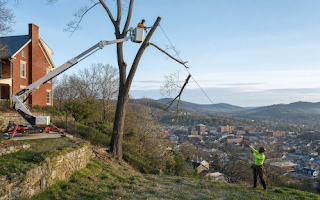
Quick question. When did you last look up at the trees over your house?
Most people in Staunton could not say. That is normal. Trees change slowly, then all at once.
The ground here is thin soil over limestone, with bedrock close to the surface in places, and the terrain is steep city hills stacked above a downtown built in a hollow. Both matter more than people expect. Below we walk through tree removal, pruning and stump grinding as they actually play out in Staunton.
Removal is the last option, not the first. But when a tree is dead, split, or leaning toward something you care about, waiting only makes it more expensive.
Here is when we say take it down:
On Staunton properties we see this most with sugar maple and ginkgo. Both grow fast, and fast growth means weaker wood.
Two options exist: grinding and full extraction.
Grinding chews the stump into chips down below ground level. It is fast, it leaves the surrounding lawn intact, and it is what we recommend almost every time.
Full extraction pulls the root ball out with a machine. It leaves a crater, tears up whatever is around it, and costs considerably more. It only makes sense if you are building on the spot.
For a yard in Staunton, grinding is the answer.
We arrive, walk the site with you, and confirm the plan before anything starts.
Then we set up. That means protecting the lawn, moving what needs moving, and setting rigging points if the tree cannot be dropped in one piece.
The cutting is usually the shortest part. Cleanup takes longer than people expect, because doing it properly means raking, not just picking up the big pieces.
Before we leave, we walk the site with you again.
Think of pruning as maintenance, not decoration.
What we take out:
What we leave: enough canopy for the tree to feed itself. Take too much and the tree goes into shock. The rule we work by is no more than a quarter of the living canopy in one season.
Sugar maple and ginkgo both respond well to this when it is done at the right time of year.
Healthy mature trees add value. Dangerous ones subtract it.
A buyer walking a property notices a dead tree over the roofline, and their inspector will note it. It becomes a negotiating point, and the number they knock off is usually more than the removal would have cost.
The reverse is also true. A well-kept canopy is one of the first things people notice about a property, and it is not something a new owner can create quickly.
Trees rarely fail without warning. The warnings are just easy to miss.
The clearest one is fungus at the base. Fungus eats wood. If it is fruiting on the outside, the inside has already been going for a while.
The second is a canopy that thins from the top down. A tree that dies back at the crown is telling you the root system cannot supply it anymore.
The third is movement. If the soil at the base heaves when the wind blows, the roots have let go.
Every area in this valley has its own quirks. Here is what defines Staunton: steep city hills stacked above a downtown built in a hollow.
Historic districts here mean removals often need care around old walls, slate roofs, and iron fencing.
Knowing this ahead of time changes how we quote a job. We can tell before we arrive whether we are likely dealing with shallow roots, soft ground, rock, or an access problem.
Do you handle small jobs?
Yes. One limb over a driveway counts.
Do you do farms and large acreage?
Yes, and we would rather walk the whole property once than come back four times.
What if the tree is on a slope?
It changes the rigging plan and sometimes the equipment. It does not stop the job.
Do you clean up?
Always. Raked, not just picked over.
The common species here, and what each one tends to do:
Knowing the species tells us how the wood will behave under a saw, which matters when we are lowering pieces over a roof.
Our regular route covers Staunton, plus Verona, Churchville, and Fishersville.
Being local matters for two reasons. We can get to an emergency quickly, and we already know the ground, the access issues along Beverley Street, Churchville Avenue, and the steep residential blocks off them, and what grows where.
We are not a crew driving in from three counties over after a storm.
Ask any tree company for two documents: general liability and workers compensation.
Here is why the second one matters to you. If an uninsured worker is hurt on your property, you can end up responsible. Your homeowners policy may not cover it.
We carry both, and we will hand you the certificates before we start.
This matters most after storms, when out-of-area crews show up around Staunton looking for cash work. Some are legitimate. Many are not.
Losing a mature tree changes a yard. More sun, less shelter, different drainage.
If you are replanting in Staunton, match the tree to the spot. Small ornamental near the house. Large shade tree well out from the foundation, ideally thirty feet or more.
Give the new tree room to reach full size. The mistake almost everyone makes is planting something that looks proportional today and will be pressed against the siding in twenty years.
If you have a tree in Staunton you are unsure about, we will come look at it and tell you straight whether it needs to go.
No pressure, no charge for the estimate, and a written price before any work starts.


.jpg)


