

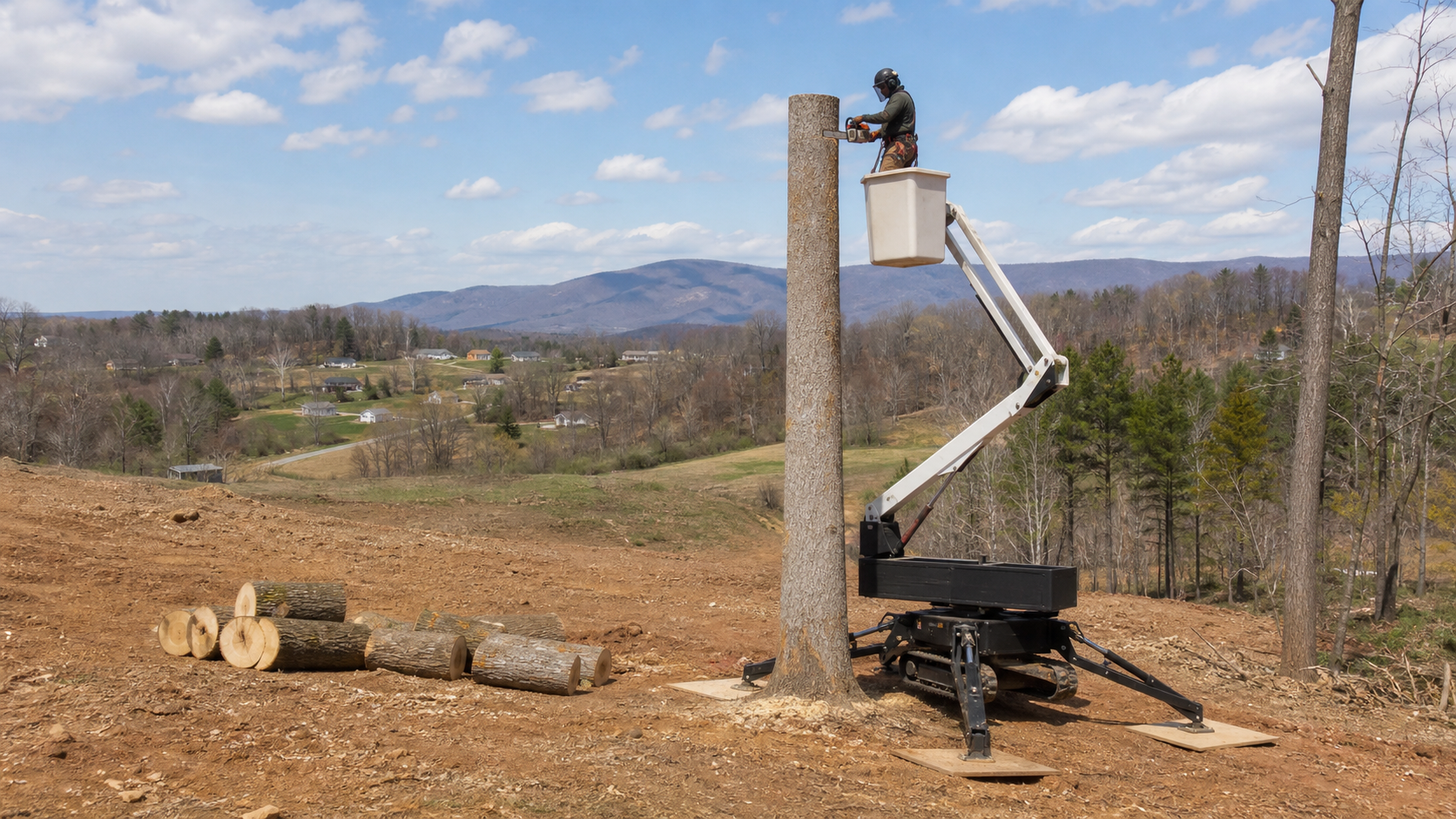
Trees left standing after clearing have no wind training and fail early. That is the short version of why we get so many calls from Penn Laird.
The longer version has to do with soil. Around here it is mixed clay and rock, drains unevenly across a single lot. Add red maple and white pine that grow fast and hold water, and you get trees that look fine right up until they are not.
This page covers the three things Penn Laird property owners ask us for most: removal, pruning, and stump grinding.
From Route 33 and Peak View out to McGaheysville, Harrisonburg, and Massanutten, we work the whole area regularly.
Residential, farm, commercial, HOA. Single trees and whole lots.
If you have several properties in the area, we can look at all of them in one visit and quote them together, which usually costs less than handling them separately.
We arrive, walk the site with you, and confirm the plan before anything starts.
Then we set up. That means protecting the lawn, moving what needs moving, and setting rigging points if the tree cannot be dropped in one piece.
The cutting is usually the shortest part. Cleanup takes longer than people expect, because doing it properly means raking, not just picking up the big pieces.
Before we leave, we walk the site with you again.
Storms here do not give much warning. Trees left standing after clearing have no wind training and fail early.
Red maple is one of the first to show damage, because the wood is not as strong as the tree's size suggests. Big canopy, weak fiber.
We handle emergency removals across Penn Laird and out to McGaheysville, Harrisonburg, and Massanutten. That means cutting a tree off a roof, clearing a blocked drive, or taking down something that survived the storm but will not survive the next one.
Every area in this valley has its own quirks. Here is what defines Penn Laird: a long gradual slope between Harrisonburg and the Massanutten foothills.
When a subdivision keeps a few tall poplars from the original woods, those trees are the first to come down in a storm.
Knowing this ahead of time changes how we quote a job. We can tell before we arrive whether we are likely dealing with shallow roots, soft ground, rock, or an access problem.
Winter is our quieter season, and that works in your favor.
Frozen or firm ground means equipment can get places it cannot reach in spring mud. Bare canopies make assessment easier. And scheduling is more flexible.
The busiest stretch is right after summer storms, when everybody calls at once. If you already know a tree needs to come down, dealing with it in January beats competing for a slot in July.
Cutting a tree down leaves a stump. Grinding it out is a separate job, and it is worth doing.
Left alone, a stump attracts carpenter ants and termites, sends up shoots you have to keep cutting, and sits there as a mowing obstacle for years. Hardwood stumps can take a decade or more to rot on their own.
Our grinder takes it down six to twelve inches below grade. You get a hole full of wood chips, which you can leave, use as mulch, or replace with topsoil and seed.
Ground here is mixed clay and rock, drains unevenly across a single lot, which affects how deep we can go and how fast the work moves.
Can you save my tree instead of removing it?
Often, yes. We will tell you honestly either way.
What about the neighbor's tree hanging over my yard?
In Virginia you can generally trim back to the property line, but not enough to kill the tree. Talking to the neighbor first saves a lot of trouble.
Does insurance cover this?
Usually only if the tree has hit a structure. A tree that fell in the yard is normally on you.
How soon can you come?
Emergencies same or next day. Normal work is scheduled.
Anything within ten feet of a power line is not a homeowner job. It is often not a tree company job either.
The line from the pole to your house is usually your responsibility. The lines along the road are the utility's. Knowing which is which decides who you call.
Electricity can arc. You do not have to touch a line to be hurt by it, and a wet branch conducts.
If a tree is in a line, call the utility first. Then call us for whatever is left.
Trees rarely fail without warning. The warnings are just easy to miss.
The clearest one is fungus at the base. Fungus eats wood. If it is fruiting on the outside, the inside has already been going for a while.
The second is a canopy that thins from the top down. A tree that dies back at the crown is telling you the root system cannot supply it anymore.
The third is movement. If the soil at the base heaves when the wind blows, the roots have let go.
Trees in yards grow differently than trees in forests.
In the woods, competition forces a tree to grow straight up with a single strong trunk. In an open yard, the same species spreads wide and often splits into two or three trunks. Those splits are where trees break.
Pruning early corrects that. A young black walnut shaped properly at ten years old will not need an emergency call at forty.
If your trees are already mature, we work with what is there. Reduce the heavy ends, clear the dead, take pressure off the weak unions.
Losing a mature tree changes a yard. More sun, less shelter, different drainage.
If you are replanting in Penn Laird, match the tree to the spot. Small ornamental near the house. Large shade tree well out from the foundation, ideally thirty feet or more.
Give the new tree room to reach full size. The mistake almost everyone makes is planting something that looks proportional today and will be pressed against the siding in twenty years.
Not every ugly tree is a dangerous tree. And not every healthy-looking tree is safe.
We look at three things before recommending removal: the condition of the trunk, the amount of dead wood in the canopy, and what is underneath it.
A hollow red maple in the middle of a pasture can stand for years. The same tree twelve feet from a bedroom wall is a different conversation entirely.
If we think a tree can be saved with pruning, we will tell you that. We would rather do a smaller job and keep your business than sell you a removal you did not need.
Removal, pruning, stump grinding. Penn Laird and everywhere around it.
Send a photo or give us a call. We will tell you what we think, and we will tell you if you do not need us.


.jpg)


