

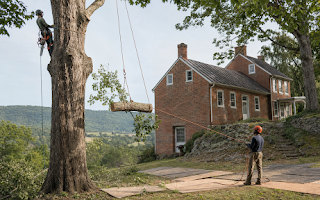
Some trees you save. Some you take down. Knowing which is which is most of the job.
In Middlebrook, the mix leans toward sugar maple and white oak, growing in rocky hill ground with shallow topsoil on the slopes. The village core is a historic district, so removals near the old buildings need a careful drop plan.
We serve Middlebrook and the surrounding area near the Middlebrook historic district and the surrounding hills. Here is our approach to tree removal, pruning and stump grinding.
Overhanging limbs cost you in ways that are easy to overlook.
They drop leaves into gutters, which hold water against fascia boards. They shed debris onto shingles, which keeps the roof damp and shortens its life. They give squirrels a bridge onto your roof.
Clearance pruning fixes all of that without taking the tree. It is one of the cheapest pieces of home maintenance there is.
Call or send photos. For anything straightforward, photos and a description are often enough for a ballpark number.
For a real quote we come out. There is no charge for that, and no obligation.
What helps us most: a photo of the whole tree from a distance, a photo of the base, and a note about access. Can a truck get to it? Is there a gate, and how wide?
We cover Middlebrook and the surrounding area, so scheduling a look is usually quick.
Timing matters more than most people realize.
Late winter is best for most hardwoods here. The tree is dormant, the structure is visible with the leaves off, and wounds seal fast when growth restarts in spring.
Some exceptions: oaks should not be pruned in spring or early summer because of oak wilt risk. Maples and birches bleed sap heavily if cut late winter, which looks alarming but does not hurt them.
Dead wood can come out any time. If a limb is already dead, there is nothing to wait for.
A dead tree gets more dangerous every month it stands.
The wood dries out and loses flex. Roots rot below ground where nobody can see them. Then a normal windy afternoon does what a storm could not.
Dead trees are also harder and riskier to remove than live ones, because nothing holds together the way it should. That is why removal costs go up the longer you wait.
In Middlebrook we see a lot of this with standing ash and with older sugar maple.
Middlebrook sits on hilly southwestern county ground with long views and steep pasture. The soil is rocky hill ground with shallow topsoil on the slopes.
That combination decides a lot. It sets which species thrive, how deep roots go, and how the ground behaves when it is saturated.
The village core is a historic district, so removals near the old buildings need a careful drop plan.
A crew that works the whole valley without paying attention to this will misjudge jobs here. We would rather know the ground before we bring equipment onto it.
You can learn most of what you need from the ground.
Stand back far enough to see the whole tree. Is the canopy full and even, or is one side thin? Are there bare branches sticking up above the leaves?
Then walk up to the base. Look for fungus, loose bark, and soil that looks disturbed or lifted.
Then walk a circle around it and look up. Broken limbs caught in the canopy are common and easy to spot once you are looking for them.
That five-minute check catches most serious problems.
The common species here, and what each one tends to do:
Knowing the species tells us how the wood will behave under a saw, which matters when we are lowering pieces over a roof.
From the Middlebrook historic district and the surrounding hills out to Greenville, Swoope, and Staunton, we work the whole area regularly.
Residential, farm, commercial, HOA. Single trees and whole lots.
If you have several properties in the area, we can look at all of them in one visit and quote them together, which usually costs less than handling them separately.
Hilltop trees catch wind from every direction with nothing to shield them.
After a storm, the dangerous work is not the tree that already fell. It is the one that is half down, hung up in another tree, or resting on a roof with all its weight still loaded.
Those are under tension. Cut in the wrong place and the whole thing moves at once.
If you have a tree on a structure or across a driveway in Middlebrook, call us and stay away from it. Do not try to cut it loose yourself.
A few things genuinely reduce what you pay:
What does not save money: hiring the cheapest uninsured crew that knocks on your door after a storm.
Can you save my tree instead of removing it?
Often, yes. We will tell you honestly either way.
What about the neighbor's tree hanging over my yard?
In Virginia you can generally trim back to the property line, but not enough to kill the tree. Talking to the neighbor first saves a lot of trouble.
Does insurance cover this?
Usually only if the tree has hit a structure. A tree that fell in the yard is normally on you.
How soon can you come?
Emergencies same or next day. Normal work is scheduled.
Grinding is straightforward, but the setup matters.
We clear the area, mark anything underground, and check for rocks packed against the stump. Rocks are the main thing that slows a grinder down or damages the teeth, and in Middlebrook the soil is rocky hill ground with shallow topsoil on the slopes, so we check carefully.
Then the wheel goes to work, side to side, cutting a few inches deeper each pass. The whole thing turns into a mound of chips.
We haul the chips away or leave them for you, whichever you prefer.
One dead limb or a whole lot to clear, the process is the same. We look, we quote, we do the work, we clean up.
Serving Middlebrook, Virginia and the surrounding communities.


.jpg)


