

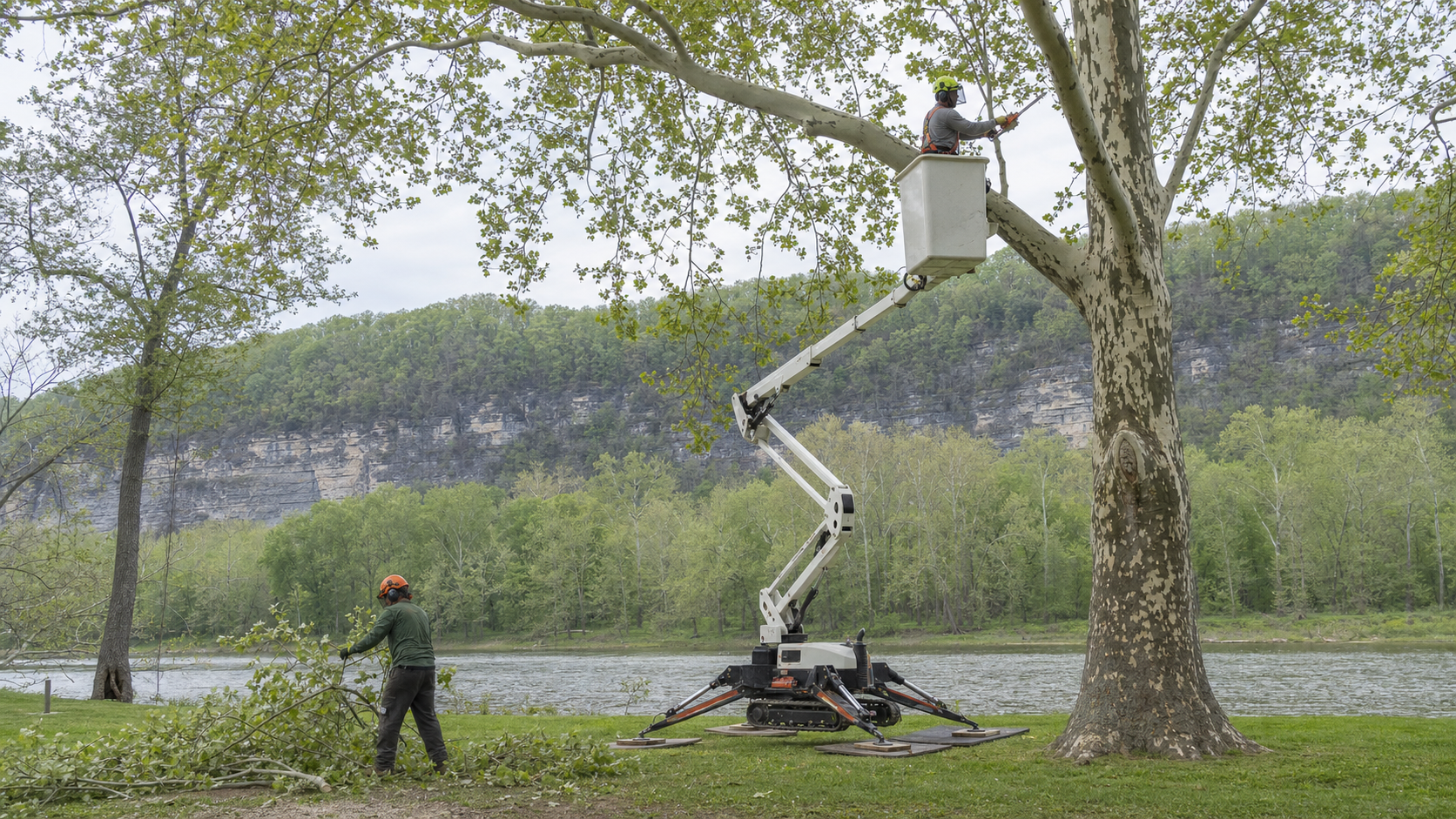
Quick question. When did you last look up at the trees over your house?
Most people in Grottoes could not say. That is normal. Trees change slowly, then all at once.
The ground here is alluvial soil over limestone, prone to sinkholes near the caverns, and the terrain is flat riverside ground at the foot of the Blue Ridge, right on the county line. Both matter more than people expect. Below we walk through tree removal, pruning and stump grinding as they actually play out in Grottoes.
Think of pruning as maintenance, not decoration.
What we take out:
What we leave: enough canopy for the tree to feed itself. Take too much and the tree goes into shock. The rule we work by is no more than a quarter of the living canopy in one season.
Sycamore and silver maple both respond well to this when it is done at the right time of year.
Two options exist: grinding and full extraction.
Grinding chews the stump into chips down below ground level. It is fast, it leaves the surrounding lawn intact, and it is what we recommend almost every time.
Full extraction pulls the root ball out with a machine. It leaves a crater, tears up whatever is around it, and costs considerably more. It only makes sense if you are building on the spot.
For a yard in Grottoes, grinding is the answer.
South River flooding leaves root systems sitting in standing water for days.
After a storm, the dangerous work is not the tree that already fell. It is the one that is half down, hung up in another tree, or resting on a roof with all its weight still loaded.
Those are under tension. Cut in the wrong place and the whole thing moves at once.
If you have a tree on a structure or across a driveway in Grottoes, call us and stay away from it. Do not try to cut it loose yourself.
Chainsaw injuries are common. Tree work injuries are worse.
The problem is not the cutting. It is the physics. A limb under tension stores energy, and when you release it in the wrong order it moves fast and in a direction you did not predict.
Add height, add a ladder, add a running saw, and the margin for error disappears.
Small pruning you can reach from the ground is fine. Anything requiring a ladder, or anything near a wire, is not worth it.
Can you save my tree instead of removing it?
Often, yes. We will tell you honestly either way.
What about the neighbor's tree hanging over my yard?
In Virginia you can generally trim back to the property line, but not enough to kill the tree. Talking to the neighbor first saves a lot of trouble.
Does insurance cover this?
Usually only if the tree has hit a structure. A tree that fell in the yard is normally on you.
How soon can you come?
Emergencies same or next day. Normal work is scheduled.
Overhanging limbs cost you in ways that are easy to overlook.
They drop leaves into gutters, which hold water against fascia boards. They shed debris onto shingles, which keeps the roof damp and shortens its life. They give squirrels a bridge onto your roof.
Clearance pruning fixes all of that without taking the tree. It is one of the cheapest pieces of home maintenance there is.
Removal is the last option, not the first. But when a tree is dead, split, or leaning toward something you care about, waiting only makes it more expensive.
Here is when we say take it down:
On Grottoes properties we see this most with sycamore and silver maple. Both grow fast, and fast growth means weaker wood.
Winter is our quieter season, and that works in your favor.
Frozen or firm ground means equipment can get places it cannot reach in spring mud. Bare canopies make assessment easier. And scheduling is more flexible.
The busiest stretch is right after summer storms, when everybody calls at once. If you already know a tree needs to come down, dealing with it in January beats competing for a slot in July.
Grottoes sits on flat riverside ground at the foot of the Blue Ridge, right on the county line. The soil is alluvial soil over limestone, prone to sinkholes near the caverns.
That combination decides a lot. It sets which species thrive, how deep roots go, and how the ground behaves when it is saturated.
Grottoes straddles the Rockingham and Augusta line, so nearby properties fall under different county rules.
A crew that works the whole valley without paying attention to this will misjudge jobs here. We would rather know the ground before we bring equipment onto it.
From Grand Caverns and the South River out to Port Republic, Crimora, and Elkton, we work the whole area regularly.
Residential, farm, commercial, HOA. Single trees and whole lots.
If you have several properties in the area, we can look at all of them in one visit and quote them together, which usually costs less than handling them separately.
A few things genuinely reduce what you pay:
What does not save money: hiring the cheapest uninsured crew that knocks on your door after a storm.
The common species here, and what each one tends to do:
Knowing the species tells us how the wood will behave under a saw, which matters when we are lowering pieces over a roof.
If you have a tree in Grottoes you are unsure about, we will come look at it and tell you straight whether it needs to go.
No pressure, no charge for the estimate, and a written price before any work starts.


.jpg)


