

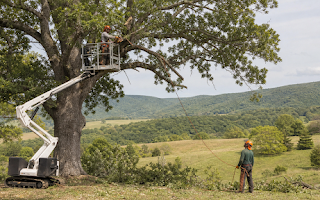
A dead tree does not stay put forever. It waits for wind.
In Greenville, wind on the open rolling ground twists rather than pushes. Between that and rolling limestone ground, well drained on the rises, we see a steady stream of failures that could have been caught months earlier.
Here is what we do about it: removal when a tree is past saving, pruning when it is not, and stump grinding so you get your yard back.
Good pruning does two things. It takes out what is already dead, and it shapes what is left so the tree carries its own weight properly.
Done right, it can add decades to a tree's life. Done wrong, it kills it slowly.
The most common mistake we fix in Greenville is topping. Somebody cuts the top off a tree to make it shorter. The tree responds by throwing up dozens of weak shoots that are attached badly and break easily. Five years later that tree is more dangerous than before it was cut.
We do not top trees. We reduce them properly, back to a growth point that can support the wound.
Every area in this valley has its own quirks. Here is what defines Greenville: rolling southern county farmland along Route 11.
Several trees along the old pike here are older than the road's paving.
Knowing this ahead of time changes how we quote a job. We can tell before we arrive whether we are likely dealing with shallow roots, soft ground, rock, or an access problem.
We arrive, walk the site with you, and confirm the plan before anything starts.
Then we set up. That means protecting the lawn, moving what needs moving, and setting rigging points if the tree cannot be dropped in one piece.
The cutting is usually the shortest part. Cleanup takes longer than people expect, because doing it properly means raking, not just picking up the big pieces.
Before we leave, we walk the site with you again.
A few things genuinely reduce what you pay:
What does not save money: hiring the cheapest uninsured crew that knocks on your door after a storm.
A stump is not neutral. It is a slow problem.
Grinding it out takes an hour on most jobs. Living with it takes years.
Do you handle small jobs?
Yes. One limb over a driveway counts.
Do you do farms and large acreage?
Yes, and we would rather walk the whole property once than come back four times.
What if the tree is on a slope?
It changes the rigging plan and sometimes the equipment. It does not stop the job.
Do you clean up?
Always. Raked, not just picked over.
Anything within ten feet of a power line is not a homeowner job. It is often not a tree company job either.
The line from the pole to your house is usually your responsibility. The lines along the road are the utility's. Knowing which is which decides who you call.
Electricity can arc. You do not have to touch a line to be hurt by it, and a wet branch conducts.
If a tree is in a line, call the utility first. Then call us for whatever is left.
Healthy mature trees add value. Dangerous ones subtract it.
A buyer walking a property notices a dead tree over the roofline, and their inspector will note it. It becomes a negotiating point, and the number they knock off is usually more than the removal would have cost.
The reverse is also true. A well-kept canopy is one of the first things people notice about a property, and it is not something a new owner can create quickly.
The honest answer is that the best time to deal with a dangerous tree is now.
That said, if there is no urgency, here is the ideal calendar:
Most removals in Greenville cannot be done by just cutting at the base and stepping back.
There is a house, a fence, a power line, or a septic field in the way. So we take the tree down in sections instead, roping each piece to the ground.
It is slower. It is also the difference between a clean job and a repair bill.
Species matters too. A black walnut lets go differently than a eastern red cedar, and knowing that ahead of time is how you keep the cut piece from swinging where you did not want it.
We cover Greenville and everything nearby, including Steeles Tavern, Middlebrook, and Jolivue.
That means the properties around the historic Route 11 corridor south of Staunton, along Route 11, Route 608, and the farm lanes east and west, and out on the rural parcels past them.
If you are not sure whether you are in our area, just ask. We are usually working somewhere close by already.
The tree mix in Greenville runs heavily toward white oak, black walnut and eastern red cedar, with sugar maple and hickory filling in.
Two of these are worth flagging.
Ash of any kind in this region is either dead or dying from emerald ash borer. If you have standing ash, assume it is on the clock.
Anything with multiple trunks joined at the base is a candidate for splitting, whatever the species. That is a structure problem, not a health problem, and it is worth having looked at.
Wind and ice damage trees differently.
Wind pushes. It takes trees over at the roots when the ground is soft, or snaps trunks where there is already decay inside.
Ice loads. A quarter inch of ice can add hundreds of pounds to a single limb. Trees with wide horizontal branching, like black walnut, take the worst of it.
In Greenville, wind on the open rolling ground twists rather than pushes. Both kinds of damage show up here.
Tree removal is only part of what we do here, though it is what most people call about.
Most people call after a tree becomes a problem. It is cheaper to call before.
Either way, we are here. Serving Greenville and the surrounding area with honest estimates and clean work.


.jpg)


