

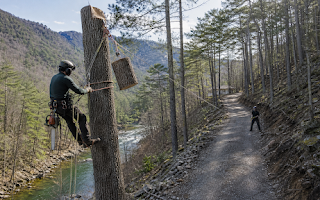
Some trees you save. Some you take down. Knowing which is which is most of the job.
In Fort Valley, the mix leans toward chestnut oak and white pine, growing in rocky mountain ground with pockets of better soil along the creek. Access roads in and out are narrow, so equipment size has to be planned before the job starts.
We serve Fort Valley and the surrounding area near the ridges of Massanutten and the Passage Creek watershed. Here is our approach to tree removal, pruning and stump grinding.
Anything within ten feet of a power line is not a homeowner job. It is often not a tree company job either.
The line from the pole to your house is usually your responsibility. The lines along the road are the utility's. Knowing which is which decides who you call.
Electricity can arc. You do not have to touch a line to be hurt by it, and a wet branch conducts.
If a tree is in a line, call the utility first. Then call us for whatever is left.
Timing matters more than most people realize.
Late winter is best for most hardwoods here. The tree is dormant, the structure is visible with the leaves off, and wounds seal fast when growth restarts in spring.
Some exceptions: oaks should not be pruned in spring or early summer because of oak wilt risk. Maples and birches bleed sap heavily if cut late winter, which looks alarming but does not hurt them.
Dead wood can come out any time. If a limb is already dead, there is nothing to wait for.
Our regular route covers Fort Valley, plus Basye, Woodstock, and Front Royal.
Being local matters for two reasons. We can get to an emergency quickly, and we already know the ground, the access issues along Fort Valley Road and the gravel lanes off it, and what grows where.
We are not a crew driving in from three counties over after a storm.
Trees rarely fail without warning. The warnings are just easy to miss.
The clearest one is fungus at the base. Fungus eats wood. If it is fruiting on the outside, the inside has already been going for a while.
The second is a canopy that thins from the top down. A tree that dies back at the crown is telling you the root system cannot supply it anymore.
The third is movement. If the soil at the base heaves when the wind blows, the roots have let go.
Storms here do not give much warning. Wind swirls inside the enclosed valley and comes from odd directions.
Chestnut oak is one of the first to show damage, because the wood is not as strong as the tree's size suggests. Big canopy, weak fiber.
We handle emergency removals across Fort Valley and out to Basye, Woodstock, and Front Royal. That means cutting a tree off a roof, clearing a blocked drive, or taking down something that survived the storm but will not survive the next one.
A dead tree gets more dangerous every month it stands.
The wood dries out and loses flex. Roots rot below ground where nobody can see them. Then a normal windy afternoon does what a storm could not.
Dead trees are also harder and riskier to remove than live ones, because nothing holds together the way it should. That is why removal costs go up the longer you wait.
In Fort Valley we see a lot of this with standing ash and with older chestnut oak.
Do you handle small jobs?
Yes. One limb over a driveway counts.
Do you do farms and large acreage?
Yes, and we would rather walk the whole property once than come back four times.
What if the tree is on a slope?
It changes the rigging plan and sometimes the equipment. It does not stop the job.
Do you clean up?
Always. Raked, not just picked over.
A removal leaves a gap. Worth thinking about what goes there.
If you grind the stump, wait before replanting in the exact spot. The chips left behind pull nitrogen out of the soil as they break down, which starves a young tree. Either haul the chips and backfill with topsoil, or plant a few feet away.
Also worth doing: pick a species that fits the space at full size, not at nursery size. Most tree problems start as a planting decision made thirty years earlier.
The common species here, and what each one tends to do:
Knowing the species tells us how the wood will behave under a saw, which matters when we are lowering pieces over a roof.
Grinding is straightforward, but the setup matters.
We clear the area, mark anything underground, and check for rocks packed against the stump. Rocks are the main thing that slows a grinder down or damages the teeth, and in Fort Valley the soil is rocky mountain ground with pockets of better soil along the creek, so we check carefully.
Then the wheel goes to work, side to side, cutting a few inches deeper each pass. The whole thing turns into a mound of chips.
We haul the chips away or leave them for you, whichever you prefer.
Two trees the same height can differ a lot in price.
The one in the middle of a pasture gets felled in one cut. The one wedged between a house and a power line comes down in twenty pieces, each one roped and lowered.
Same tree, very different job.
In Fort Valley, access is often the deciding factor. Narrow drives, gates, soft ground and steep lots all change what equipment we can use.
We would rather explain that up front than surprise you with it later.
Winter is our quieter season, and that works in your favor.
Frozen or firm ground means equipment can get places it cannot reach in spring mud. Bare canopies make assessment easier. And scheduling is more flexible.
The busiest stretch is right after summer storms, when everybody calls at once. If you already know a tree needs to come down, dealing with it in January beats competing for a slot in July.
One dead limb or a whole lot to clear, the process is the same. We look, we quote, we do the work, we clean up.
Serving Fort Valley, Virginia and the surrounding communities.


.jpg)


