

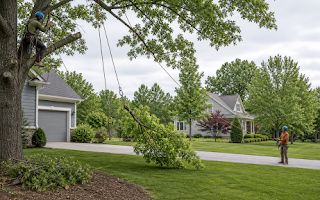
Some trees you save. Some you take down. Knowing which is which is most of the job.
In Fishersville, the mix leans toward pin oak and red maple, growing in graded construction fill over original valley loam, compacted in places. Bradford pears planted across the newer developments are now old enough to start splitting apart.
We serve Fishersville and the surrounding area near Augusta Health and the Expo Center. Here is our approach to tree removal, pruning and stump grinding.
You have options, and they affect the price.
Tell us what you want before we start and we will price it that way.
Removal can happen any time. Pruning is more particular.
Late winter is the sweet spot for most hardwoods. No leaves means we can see the structure, the tree is dormant, and cuts seal quickly come spring.
Summer works for light clearance work and dead wood removal.
Fall is the worst time for heavy pruning. The tree is shutting down and wounds stay open longer, right when fungal spores are everywhere.
Dead limbs are the exception. Those come out whenever you notice them.
Grinding is straightforward, but the setup matters.
We clear the area, mark anything underground, and check for rocks packed against the stump. Rocks are the main thing that slows a grinder down or damages the teeth, and in Fishersville the soil is graded construction fill over original valley loam, compacted in places, so we check carefully.
Then the wheel goes to work, side to side, cutting a few inches deeper each pass. The whole thing turns into a mound of chips.
We haul the chips away or leave them for you, whichever you prefer.
A few things genuinely reduce what you pay:
What does not save money: hiring the cheapest uninsured crew that knocks on your door after a storm.
Timing matters more than most people realize.
Late winter is best for most hardwoods here. The tree is dormant, the structure is visible with the leaves off, and wounds seal fast when growth restarts in spring.
Some exceptions: oaks should not be pruned in spring or early summer because of oak wilt risk. Maples and birches bleed sap heavily if cut late winter, which looks alarming but does not hurt them.
Dead wood can come out any time. If a limb is already dead, there is nothing to wait for.
Every area in this valley has its own quirks. Here is what defines Fishersville: flat to gently rolling ground between Staunton and Waynesboro.
Bradford pears planted across the newer developments are now old enough to start splitting apart.
Knowing this ahead of time changes how we quote a job. We can tell before we arrive whether we are likely dealing with shallow roots, soft ground, rock, or an access problem.
A dead tree gets more dangerous every month it stands.
The wood dries out and loses flex. Roots rot below ground where nobody can see them. Then a normal windy afternoon does what a storm could not.
Dead trees are also harder and riskier to remove than live ones, because nothing holds together the way it should. That is why removal costs go up the longer you wait.
In Fishersville we see a lot of this with standing ash and with older pin oak.
We arrive, walk the site with you, and confirm the plan before anything starts.
Then we set up. That means protecting the lawn, moving what needs moving, and setting rigging points if the tree cannot be dropped in one piece.
The cutting is usually the shortest part. Cleanup takes longer than people expect, because doing it properly means raking, not just picking up the big pieces.
Before we leave, we walk the site with you again.
The common species here, and what each one tends to do:
Knowing the species tells us how the wood will behave under a saw, which matters when we are lowering pieces over a roof.
Trees rarely fail without warning. The warnings are just easy to miss.
The clearest one is fungus at the base. Fungus eats wood. If it is fruiting on the outside, the inside has already been going for a while.
The second is a canopy that thins from the top down. A tree that dies back at the crown is telling you the root system cannot supply it anymore.
The third is movement. If the soil at the base heaves when the wind blows, the roots have let go.
Anything within ten feet of a power line is not a homeowner job. It is often not a tree company job either.
The line from the pole to your house is usually your responsibility. The lines along the road are the utility's. Knowing which is which decides who you call.
Electricity can arc. You do not have to touch a line to be hurt by it, and a wet branch conducts.
If a tree is in a line, call the utility first. Then call us for whatever is left.
Here is what to do first, in order:
Newly planted and newly exposed trees fail at a high rate here, so this is a routine we walk Fishersville property owners through more often than we would like.
One dead limb or a whole lot to clear, the process is the same. We look, we quote, we do the work, we clean up.
Serving Fishersville, Virginia and the surrounding communities.


.jpg)


