

Quick question. When did you last look up at the trees over your house?
Most people in Edinburg could not say. That is normal. Trees change slowly, then all at once.
The ground here is creek-bottom silt that scours out from around root flares, and the terrain is a small town on Stony Creek where it runs down to the North Fork. Both matter more than people expect. Below we walk through tree removal, pruning and stump grinding as they actually play out in Edinburg.
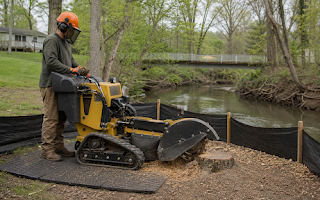
Two options exist: grinding and full extraction.
Grinding chews the stump into chips down below ground level. It is fast, it leaves the surrounding lawn intact, and it is what we recommend almost every time.
Full extraction pulls the root ball out with a machine. It leaves a crater, tears up whatever is around it, and costs considerably more. It only makes sense if you are building on the spot.
For a yard in Edinburg, grinding is the answer.
Every area in this valley has its own quirks. Here is what defines Edinburg: a small town on Stony Creek where it runs down to the North Fork.
Creek-side sycamores here get undercut a little more every year until they finally go.
Knowing this ahead of time changes how we quote a job. We can tell before we arrive whether we are likely dealing with shallow roots, soft ground, rock, or an access problem.
From the Edinburg Mill and Stony Creek out to Woodstock, Mount Jackson, and Basye, we work the whole area regularly.
Residential, farm, commercial, HOA. Single trees and whole lots.
If you have several properties in the area, we can look at all of them in one visit and quote them together, which usually costs less than handling them separately.
The common species here, and what each one tends to do:
Knowing the species tells us how the wood will behave under a saw, which matters when we are lowering pieces over a roof.
Overhanging limbs cost you in ways that are easy to overlook.
They drop leaves into gutters, which hold water against fascia boards. They shed debris onto shingles, which keeps the roof damp and shortens its life. They give squirrels a bridge onto your roof.
Clearance pruning fixes all of that without taking the tree. It is one of the cheapest pieces of home maintenance there is.
Winter is our quieter season, and that works in your favor.
Frozen or firm ground means equipment can get places it cannot reach in spring mud. Bare canopies make assessment easier. And scheduling is more flexible.
The busiest stretch is right after summer storms, when everybody calls at once. If you already know a tree needs to come down, dealing with it in January beats competing for a slot in July.
Losing a mature tree changes a yard. More sun, less shelter, different drainage.
If you are replanting in Edinburg, match the tree to the spot. Small ornamental near the house. Large shade tree well out from the foundation, ideally thirty feet or more.
Give the new tree room to reach full size. The mistake almost everyone makes is planting something that looks proportional today and will be pressed against the siding in twenty years.
Storms here do not give much warning. Stony Creek rises fast and undercuts the trees right along it.
Sycamore is one of the first to show damage, because the wood is not as strong as the tree's size suggests. Big canopy, weak fiber.
We handle emergency removals across Edinburg and out to Woodstock, Mount Jackson, and Basye. That means cutting a tree off a roof, clearing a blocked drive, or taking down something that survived the storm but will not survive the next one.
Think of pruning as maintenance, not decoration.
What we take out:
What we leave: enough canopy for the tree to feed itself. Take too much and the tree goes into shock. The rule we work by is no more than a quarter of the living canopy in one season.
Sycamore and silver maple both respond well to this when it is done at the right time of year.
Anything within ten feet of a power line is not a homeowner job. It is often not a tree company job either.
The line from the pole to your house is usually your responsibility. The lines along the road are the utility's. Knowing which is which decides who you call.
Electricity can arc. You do not have to touch a line to be hurt by it, and a wet branch conducts.
If a tree is in a line, call the utility first. Then call us for whatever is left.
Removal is the last option, not the first. But when a tree is dead, split, or leaning toward something you care about, waiting only makes it more expensive.
Here is when we say take it down:
On Edinburg properties we see this most with sycamore and silver maple. Both grow fast, and fast growth means weaker wood.
Trees rarely fail without warning. The warnings are just easy to miss.
The clearest one is fungus at the base. Fungus eats wood. If it is fruiting on the outside, the inside has already been going for a while.
The second is a canopy that thins from the top down. A tree that dies back at the crown is telling you the root system cannot supply it anymore.
The third is movement. If the soil at the base heaves when the wind blows, the roots have let go.
If you have a tree in Edinburg you are unsure about, we will come look at it and tell you straight whether it needs to go.
No pressure, no charge for the estimate, and a written price before any work starts.


.jpg)


