

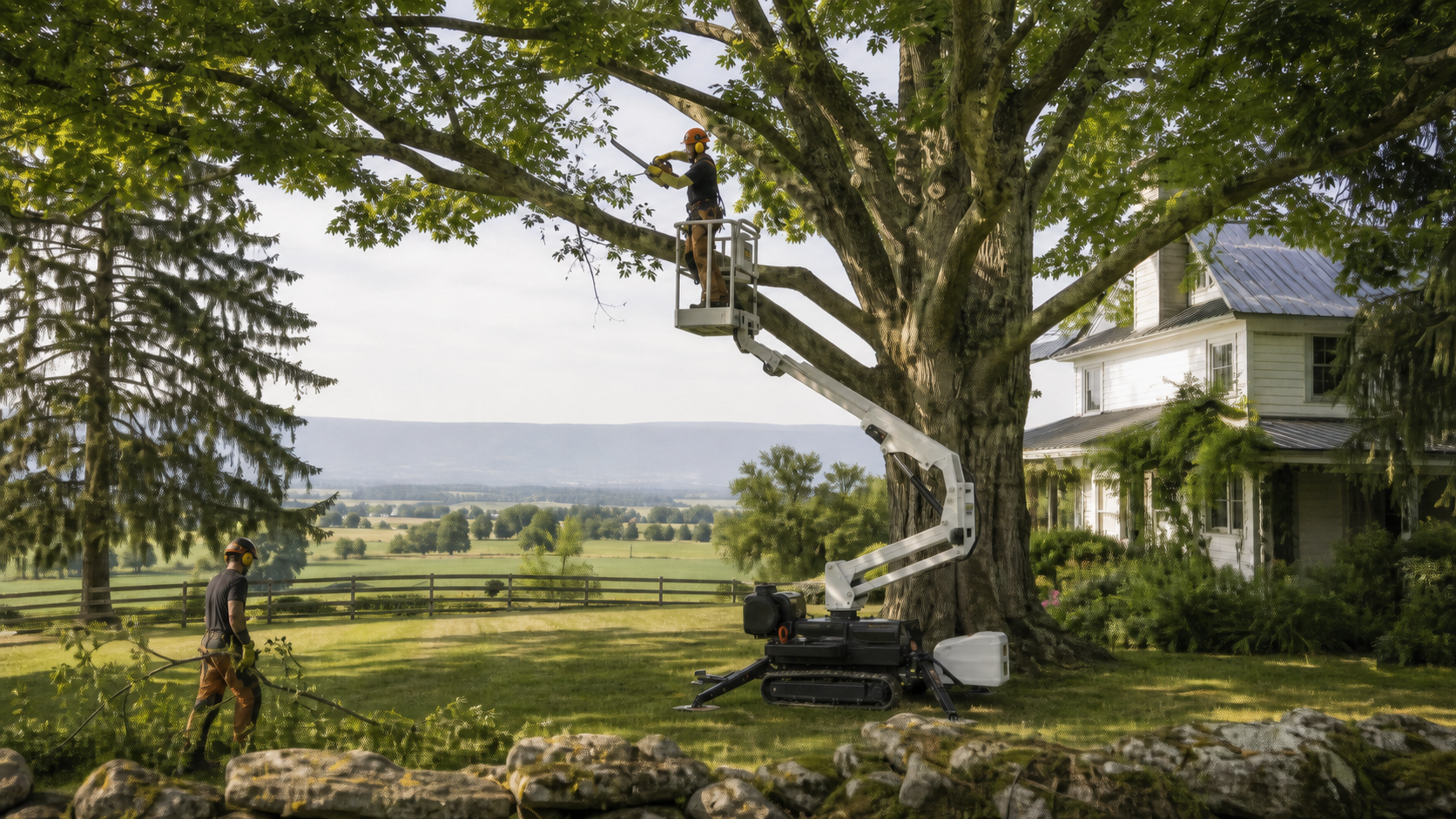
Some trees you save. Some you take down. Knowing which is which is most of the job.
In Dayton, the mix leans toward sugar maple and pin oak, growing in fertile limestone loam that grows very large trees. Several of the oldest maples in town were planted before the houses around them were built.
We serve Dayton and the surrounding area near the Dayton Farmers Market and Cooks Creek. Here is our approach to tree removal, pruning and stump grinding.
Our regular route covers Dayton, plus Bridgewater, Harrisonburg, and Mount Clinton.
Being local matters for two reasons. We can get to an emergency quickly, and we already know the ground, the access issues along Main Street, Eberly Road, and the lanes toward Bridgewater, and what grows where.
We are not a crew driving in from three counties over after a storm.
Healthy mature trees add value. Dangerous ones subtract it.
A buyer walking a property notices a dead tree over the roofline, and their inspector will note it. It becomes a negotiating point, and the number they knock off is usually more than the removal would have cost.
The reverse is also true. A well-kept canopy is one of the first things people notice about a property, and it is not something a new owner can create quickly.
A removal leaves a gap. Worth thinking about what goes there.
If you grind the stump, wait before replanting in the exact spot. The chips left behind pull nitrogen out of the soil as they break down, which starves a young tree. Either haul the chips and backfill with topsoil, or plant a few feet away.
Also worth doing: pick a species that fits the space at full size, not at nursery size. Most tree problems start as a planting decision made thirty years earlier.
Dayton sits on gentle farmland just southwest of Harrisonburg. The soil is fertile limestone loam that grows very large trees.
That combination decides a lot. It sets which species thrive, how deep roots go, and how the ground behaves when it is saturated.
Several of the oldest maples in town were planted before the houses around them were built.
A crew that works the whole valley without paying attention to this will misjudge jobs here. We would rather know the ground before we bring equipment onto it.
A few things genuinely reduce what you pay:
What does not save money: hiring the cheapest uninsured crew that knocks on your door after a storm.
Timing matters more than most people realize.
Late winter is best for most hardwoods here. The tree is dormant, the structure is visible with the leaves off, and wounds seal fast when growth restarts in spring.
Some exceptions: oaks should not be pruned in spring or early summer because of oak wilt risk. Maples and birches bleed sap heavily if cut late winter, which looks alarming but does not hurt them.
Dead wood can come out any time. If a limb is already dead, there is nothing to wait for.
Do you handle small jobs?
Yes. One limb over a driveway counts.
Do you do farms and large acreage?
Yes, and we would rather walk the whole property once than come back four times.
What if the tree is on a slope?
It changes the rigging plan and sometimes the equipment. It does not stop the job.
Do you clean up?
Always. Raked, not just picked over.
A dead tree gets more dangerous every month it stands.
The wood dries out and loses flex. Roots rot below ground where nobody can see them. Then a normal windy afternoon does what a storm could not.
Dead trees are also harder and riskier to remove than live ones, because nothing holds together the way it should. That is why removal costs go up the longer you wait.
In Dayton we see a lot of this with standing ash and with older sugar maple.
Grinding is straightforward, but the setup matters.
We clear the area, mark anything underground, and check for rocks packed against the stump. Rocks are the main thing that slows a grinder down or damages the teeth, and in Dayton the soil is fertile limestone loam that grows very large trees, so we check carefully.
Then the wheel goes to work, side to side, cutting a few inches deeper each pass. The whole thing turns into a mound of chips.
We haul the chips away or leave them for you, whichever you prefer.
The honest answer is that the best time to deal with a dangerous tree is now.
That said, if there is no urgency, here is the ideal calendar:
You do not need to identify every tree on your property. But knowing the big ones helps.
Around here that usually means sugar maple, pin oak or Norway spruce. If you can tell us the species when you call, we can usually tell you over the phone whether it sounds urgent.
If you have no idea what it is, that is fine too. Send a photo of the trunk and one of the whole tree, and we will work it out.
Four steps, every time:
No surprises added halfway through. If something unexpected comes up, we stop and talk to you before it costs you anything.
Ask any tree company for two documents: general liability and workers compensation.
Here is why the second one matters to you. If an uninsured worker is hurt on your property, you can end up responsible. Your homeowners policy may not cover it.
We carry both, and we will hand you the certificates before we start.
This matters most after storms, when out-of-area crews show up around Dayton looking for cash work. Some are legitimate. Many are not.
One dead limb or a whole lot to clear, the process is the same. We look, we quote, we do the work, we clean up.
Serving Dayton, Virginia and the surrounding communities.


.jpg)


