

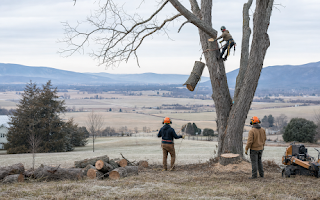
A dead tree does not stay put forever. It waits for wind.
In Augusta County, open valley wind and ice both do damage, often in the same winter. Between that and limestone valley soil in the middle, thin mountain ground at both edges, we see a steady stream of failures that could have been caught months earlier.
Here is what we do about it: removal when a tree is past saving, pruning when it is not, and stump grinding so you get your yard back.
Winter is our quieter season, and that works in your favor.
Frozen or firm ground means equipment can get places it cannot reach in spring mud. Bare canopies make assessment easier. And scheduling is more flexible.
The busiest stretch is right after summer storms, when everybody calls at once. If you already know a tree needs to come down, dealing with it in January beats competing for a slot in July.
Call or send photos. For anything straightforward, photos and a description are often enough for a ballpark number.
For a real quote we come out. There is no charge for that, and no obligation.
What helps us most: a photo of the whole tree from a distance, a photo of the base, and a note about access. Can a truck get to it? Is there a gate, and how wide?
We cover Augusta County and the surrounding area, so scheduling a look is usually quick.
A few things genuinely reduce what you pay:
What does not save money: hiring the cheapest uninsured crew that knocks on your door after a storm.
A stump is not neutral. It is a slow problem.
Grinding it out takes an hour on most jobs. Living with it takes years.
Losing a mature tree changes a yard. More sun, less shelter, different drainage.
If you are replanting in Augusta County, match the tree to the spot. Small ornamental near the house. Large shade tree well out from the foundation, ideally thirty feet or more.
Give the new tree room to reach full size. The mistake almost everyone makes is planting something that looks proportional today and will be pressed against the siding in twenty years.
Good pruning does two things. It takes out what is already dead, and it shapes what is left so the tree carries its own weight properly.
Done right, it can add decades to a tree's life. Done wrong, it kills it slowly.
The most common mistake we fix in Augusta County is topping. Somebody cuts the top off a tree to make it shorter. The tree responds by throwing up dozens of weak shoots that are attached badly and break easily. Five years later that tree is more dangerous than before it was cut.
We do not top trees. We reduce them properly, back to a growth point that can support the wound.
Augusta County sits on wide valley farmland running from the Alleghenies across to the Blue Ridge. The soil is limestone valley soil in the middle, thin mountain ground at both edges.
That combination decides a lot. It sets which species thrive, how deep roots go, and how the ground behaves when it is saturated.
On large parcels the real question is usually which trees to keep, not just which to cut.
A crew that works the whole valley without paying attention to this will misjudge jobs here. We would rather know the ground before we bring equipment onto it.
Most removals in Augusta County cannot be done by just cutting at the base and stepping back.
There is a house, a fence, a power line, or a septic field in the way. So we take the tree down in sections instead, roping each piece to the ground.
It is slower. It is also the difference between a clean job and a repair bill.
Species matters too. A black walnut lets go differently than a shagbark hickory, and knowing that ahead of time is how you keep the cut piece from swinging where you did not want it.
Open valley wind and ice both do damage, often in the same winter.
After a storm, the dangerous work is not the tree that already fell. It is the one that is half down, hung up in another tree, or resting on a roof with all its weight still loaded.
Those are under tension. Cut in the wrong place and the whole thing moves at once.
If you have a tree on a structure or across a driveway in Augusta County, call us and stay away from it. Do not try to cut it loose yourself.
The common species here, and what each one tends to do:
Knowing the species tells us how the wood will behave under a saw, which matters when we are lowering pieces over a roof.
You can learn most of what you need from the ground.
Stand back far enough to see the whole tree. Is the canopy full and even, or is one side thin? Are there bare branches sticking up above the leaves?
Then walk up to the base. Look for fungus, loose bark, and soil that looks disturbed or lifted.
Then walk a circle around it and look up. Broken limbs caught in the canopy are common and easy to spot once you are looking for them.
That five-minute check catches most serious problems.
Chainsaw injuries are common. Tree work injuries are worse.
The problem is not the cutting. It is the physics. A limb under tension stores energy, and when you release it in the wrong order it moves fast and in a direction you did not predict.
Add height, add a ladder, add a running saw, and the margin for error disappears.
Small pruning you can reach from the ground is fine. Anything requiring a ladder, or anything near a wire, is not worth it.
Most people call after a tree becomes a problem. It is cheaper to call before.
Either way, we are here. Serving Augusta County and the surrounding area with honest estimates and clean work.


.jpg)


